Astronomy
Found 20 recent publications
Supermassive Black Hole Discovered Far From Galaxy Center
Astronomers discovered a supermassive black hole 3,500 light-years from its galaxy's center after it tore apart a passing star. The rare tidal disruption event sheds light on hidden black holes.

Warwick Astronomers Discover White Dwarf Stars Can Glow in Unusual Colors Like Green and Pink
University of Warwick astronomers discovered that dense white dwarf stars can glow in unexpected colors like green, pink, and cyan, identifying the galaxy's first known green star.
First-Ever Direct Radio Signal Detected from an Exoplanet
Astronomers have detected a direct radio signal from exoplanet Beta Pictoris b for the first time, revealing a magnetic field thousands of times stronger than Earth's.
The Moon formed in just five hours: scientists discover how it happened
Perhaps one of the most dramatic events in the history of our solar system happened much faster than previously thought. According to a new study, the Moon could have formed almost entirely within just five hours following a massive collision approximately 4.5 billion years ago.
Elon Musk and NASA: Who controls the future of space exploration?
A new telescope for dark energy research has been launched. While scientists anticipate a cosmic breakthrough, the growing integration between the government space agency and the private sector continues to raise questions about the boundaries of privatization in strategic projects.
1,000 times faster than Hubble: NASA launches a new telescope to explore the "hidden universe"
NASA's Nancy Grace Roman Space Telescope, described by the agency as a "discovery machine," is set to launch from Florida. The $4.3 billion project aims to explore dark energy and dark matter.
Always Following the Sun: The Journey to the Solar Eclipse
The total solar eclipse sent me on a chase into the heart of the scorching Spanish wilderness, amidst cancellations, delays, and scientific history, after one massive sun. A travel diary.
100,000 times faster than a passenger plane: The fastest star in the Milky Way
Astronomers have discovered S301, a star orbiting the black hole at the center of the Milky Way at a speed reaching about 25,000 km/s. Researchers hope that with its help, they will be able to test Einstein's theory and measure the rotation of the black hole.
New study challenges long-held assumptions about star counts in galaxies
A 2026 study based on Gaia telescope data questions a 50-year-old astronomical assumption. Researchers from the University of Missouri found that the ratio of high-mass to low-mass stars is not universal and varies depending on the local environment.
"We were not supposed to see it": The unusual discovery in deep space
The James Webb Space Telescope has revealed a distant galaxy, JADES-GS-z13-1, posing a mystery for astronomers. The telescope detected strong radiation that, according to existing theories, should have been blocked by the neutral hydrogen prevalent in the early universe.
The new tool that will peek into distant worlds and search for clues to extraterrestrial life
Scientists are nearing the operation of a new device called "Henrietta," installed on a telescope in Chile, designed to analyze the atmospheric composition of exoplanets. Researchers hope this will help them understand conditions in worlds outside our solar system and search for substances that might indicate potential habitability.
Traveling in Europe? Don't miss the best show in the sky tonight
A solar eclipse is undoubtedly one of nature's most spectacular phenomena. Tonight, a rare and exciting event will take place for residents and travelers in Europe. Where can you watch the celestial show? Here are the details.
Ships, private jets, and fears of accidents: frenzy in Spain ahead of rare solar eclipse
A total solar eclipse will appear today in the skies over Europe for the first time since 1999, with a path crossing Siberia, Greenland, Iceland, and Spain. In Spain, where it is the first total eclipse in a century, record demand has been recorded to view the event, including the rental of private jets and ships on the high seas.
Don't miss it: the summer event in the sky is happening this week
The Perseid meteor shower reaches its peak during the night of August 12–13, 2026. We have compiled the essential tips for a perfect night of astronomical observation.
Destroyed worlds: NASA's chilling discovery at the edge of the solar system
It moves in the opposite direction, holds 99% of the mass, and tore the other moons to shreds. The James Webb Telescope reveals the greatest disaster in Neptune's history. Data that stunned the researchers.
Two sunsets in one night: The remote Spanish village becoming a global focal point
In the remote village of Uzanosa de Muño in Spain's Burgos province, life usually moves at a slow pace, with the weekly bread truck being the highlight. However, on August 12, 2026, this quiet village is set to become a global destination thanks to its perfect positioning for a total solar eclipse.
Earth's escape route: Is this the way to survive the dying Sun?
Scientific estimates state that the expansion of the Sun will bring an end to Earth, but a new groundbreaking model now presents an unexpected chance of survival and explains how the planet could dodge a cruel fate.
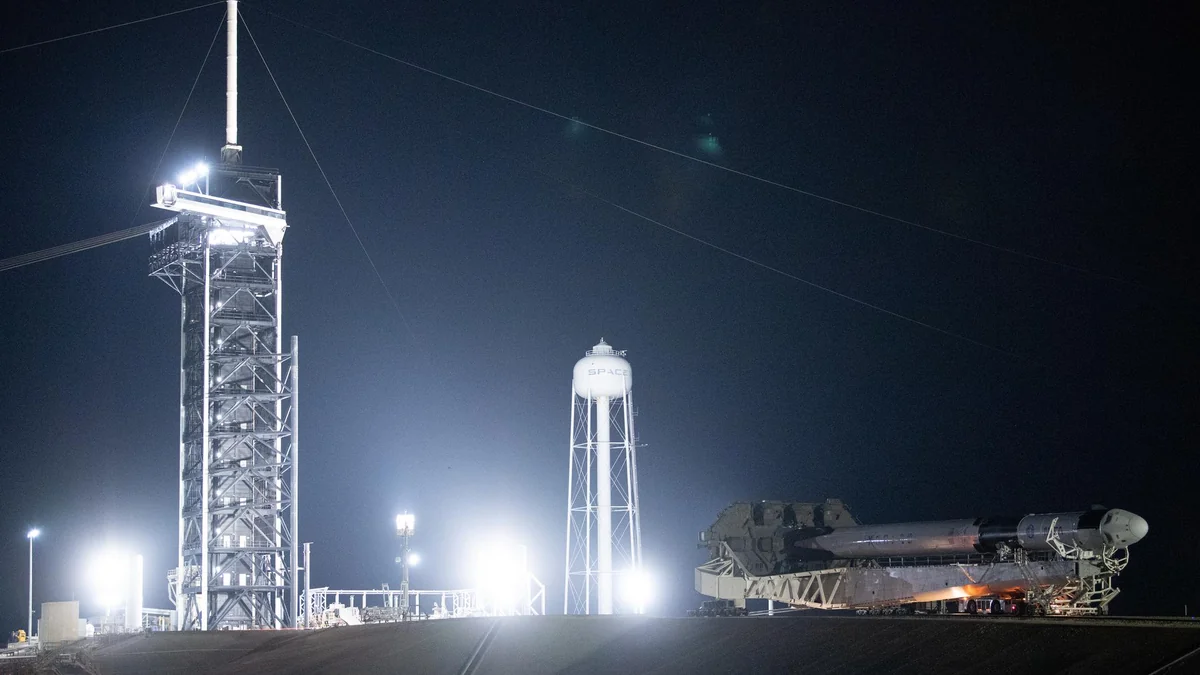
SpaceX Rocket Stage Set to Impact the Moon This Week
The upper stage of a SpaceX rocket, left in space after launching two lunar landers, is on a collision course with the Moon. It is expected to crash into the lunar surface this Wednesday.
Older Than Saturn's Rings: The Shark's Surprising Secret
Sharks have been swimming in Earth's oceans longer than Saturn's icy rings have existed. Data from the Cassini spacecraft and paleontological discoveries of 'skin teeth' are forcing a re-evaluation of the solar system's timeline and Earth's evolutionary history.
For the first time ever: An atmosphere has been identified around an Earth-like planet
Astronomers have detected helium gas for the first time in the atmosphere of LHS 1140 b - a rocky planet in the habitable zone, located 464 trillion km away. The breakthrough, made using the Magellan telescope in Chile, proves that Earth-like worlds can maintain a gas envelope for billions of years.