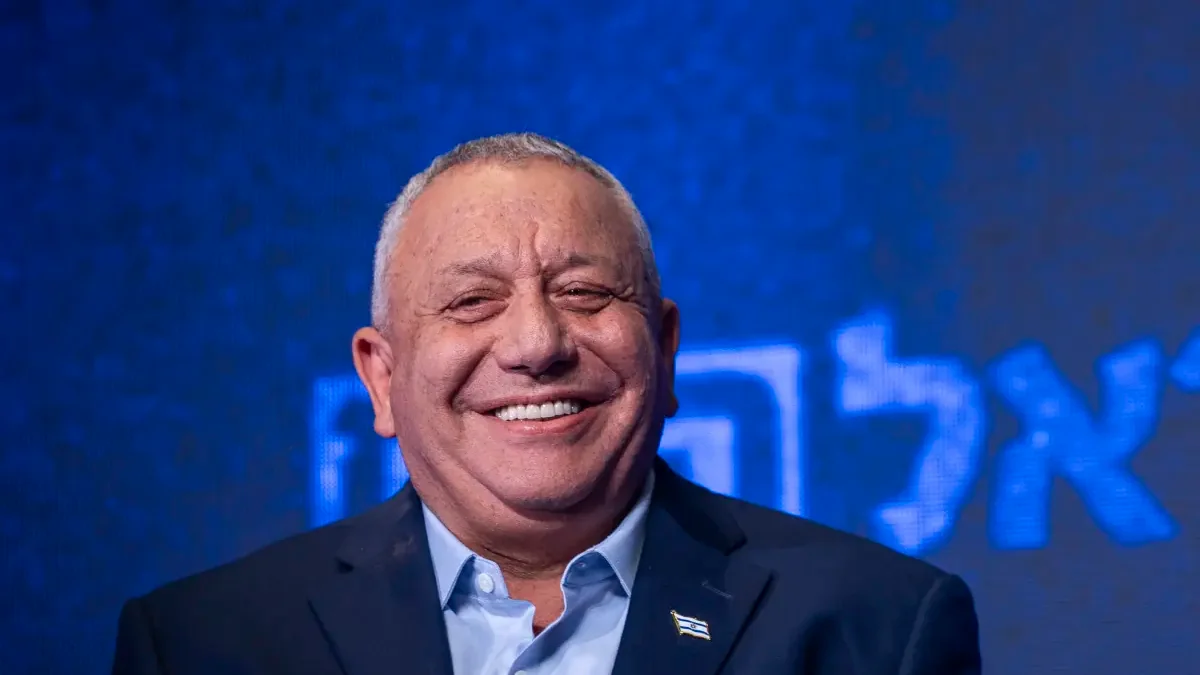
The question Bennett refuses to answer - and the political scenario that will change the country
Naftali Bennett and Avigdor Lieberman refuse to commit to supporting the leader of the bloc who receives the most mandates. Lieberman explicitly states that Gadi Eizenkot is "not yet ripe" for the premiership. Are they preparing the ground for a government led by them?
Seventy-five days until the elections and the political atmosphere is heating up. New parties are emerging, candidates are joining, and intense primaries are taking place within the Likud. However, the real storm is brewing behind closed doors. A scenario is being discussed that, if realized, would easily rank among the top five most dramatic political maneuvers in the country's history: are Naftali Bennett and Avigdor Lieberman preparing an ambush for Gadi Eizenkot?
One does not need to be a cunning strategist to understand the situation; one only needs to follow the political moves and candidate interviews with a pinch of common sense.
First working hypothesis: Naftali Bennett did not return to politics to serve as Minister of Education or Foreign Affairs. He is focused solely on the premiership. He has stated this repeatedly, and it is his legitimate right.
Second working hypothesis: Bennett has already changed the rules of politics once. After signing a pledge not to sit with Yair Lapid, he demanded and secured the premiership with only six mandates. Political precedents do not simply disappear.
Third working hypothesis is confirmed by interviews. On July 25, Keren Marciano asked Bennett: "Who is the change camp's candidate for Prime Minister?" Bennett evaded the question, shifting the focus to the conscription of the ultra-Orthodox. When pressed on whether he would recommend the candidate who receives the most votes, he again deflected, stating that "the public will decide." Later, in an interview with Ben Caspit and Amit Segal, when asked if Eizenkot was the candidate for Prime Minister, Bennett replied: "We will know how to manage."
Into this political cauldron, one must add Avigdor Lieberman—a seasoned player who does not hide his ambitions. When asked if he commits to not demanding the premiership with a low number of mandates, he remains evasive. Moreover, Lieberman explicitly states before the cameras: "I have the most experience, I will be Prime Minister," adding that Gadi Eizenkot is "not yet ripe" for the position.
Lieberman and Bennett do not recognize Gadi Eizenkot's leadership of the bloc. Period.
Admittedly, there is no signed document in a secret drawer confirming such a plan. This is merely a scenario, yet it is one being discussed within the rooms of opposition party candidates. It can be envisioned as follows:
The change bloc wins the elections; Bennett secures 14 mandates, Lieberman 10, totaling 24 against Eizenkot's 22-23. They hold a joint press conference, arguing that the public has shifted to the right, making it natural for a right-wing figure to be Prime Minister. They agree on a rotation: Bennett for the first two years, Lieberman for the next two. They then call on Gadi Eizenkot to accept the defense portfolio, emphasizing that "there is no time, and every day without a government is a disaster."
They would exert significant media pressure on Eizenkot, citing his own words: "I will do everything to replace the government." Eventually, Eizenkot might yield, the government would be formed, and the scenario would be complete.
Does this sound like fiction? Perhaps. But Israel's history is full of improbable political plots: from the "stinking trick" and Shaul Mofaz's move into a unity government, to Ariel Sharon's creation of Kadima, and the formation of a government with only six mandates. In Israeli politics, there is only one iron rule: anything, absolutely anything, can happen.