Israeli Opposition Debates Minority Government Scenarios and Speaker Replacement
Israel's anti-Netanyahu bloc holds a polling advantage, yet disagreements over minority governments and coalition terms threaten unity. Parties plan to challenge Speaker Amir Ohana immediately after elections.
In most polls, the anti-Netanyahu bloc enjoys an advantage over the outgoing coalition, yet Zionist change parties fail to secure the necessary majority to form a government based on current agreements. Netanyahu and his allies fall short of a majority in many polls, although some surveys grant the right-wing bloc a majority. The electoral threshold could alter seat distribution, and a small number of votes may determine whether Israel establishes a new government or enters another political campaign.
Within the camp seeking to replace Netanyahu, broad consensus exists on the necessity of regime change. Disagreements begin over how to form a government if Zionist change parties fail to collectively reach 61 mandates. Gadi Eisenkot seeks to lead the bloc and serve as the primary candidate for government formation. He firmly rejects the possibility of serving under Netanyahu, even in a rotation government, and presents the option of forming a minority government if change parties secure 58 or 59 mandates. The idea involves swearing in a government that wins a confidence vote, even without the permanent support of 61 Knesset members, subsequently attempting to broaden its parliamentary base.
Eisenkot does not conceal his ambition to achieve a much larger outcome, enabling the formation of a Zionist government without reliance on forces outside the camp. Relying on 58 or 59 mandates requires meticulous agreement with partners, particularly Naftali Bennett and Avigdor Lieberman, who oppose establishing a government relying on the support or abstention of Arab parties. Eisenkot himself has not ruled out the possibility of external support from Ra'am. In recent talks and interviews, he seeks to project confidence that progress can be achieved in stages, though an agreed formula to execute the plan remains unpresented.
From a legal standpoint, swearing in a government does not require 61 supporting votes, but rather a majority in the confidence vote. Abstention by Knesset members could allow a government to assume office even without an absolute majority. Conversely, a constructive no-confidence vote, designed to replace an incumbent government, requires the support of 61 Knesset members for an alternative government. Therefore, Eisenkot's minority government scenario remains relevant during government formation, yet does not permit the change bloc to oust an incumbent Netanyahu government through a standard majority. The political difficulty persists: who will agree to sit in such a government, who will abstain in the vote, and how will the government survive post-inauguration?
Avigdor Lieberman utterly rejects this possibility. He clarified that he will not support a minority government, even for a transitional period, insisting on a government anchored in a Zionist majority. A unity government with Netanyahu is equally unacceptable to him. From his perspective, if a suitable majority fails to materialize, the prospect of new elections is preferable to establishing a government failing to meet his stipulated conditions.
Lieberman's Alternative and Leadership Friction
Lieberman raises another possibility: incorporating Knesset members from Likud into a government without Netanyahu, or forging a Zionist majority through post-election shifts in bloc structures. He even claimed that Likud Knesset members exist who would be willing to undertake such a move. Lieberman names no names, and at this stage, no open negotiations occur with Likud Knesset members regarding joining such a government. Eisenkot seeks to establish a government even on a partial majority and attempt its subsequent expansion. Lieberman refuses to join such a government, demanding a Zionist majority upon its inception.
Naftali Bennett and Yair Lapid, heading the "BeYachad" list, likewise demand a Zionist government and refuse to base its establishment on the votes or abstentions of Arab parties. Conversely, The Democrats chair Yair Golan does not rule out cooperation with Ra'am. Disagreements among party leaders may intensify when required to decide whether to support the swearing-in of a government lacking a Zionist majority in the Knesset.
The meeting held this week between Eisenkot and Lieberman concluded with a joint statement on the necessity of increasing voter turnout. It failed to resolve the dispute over the minority government. Internal leadership competition similarly persists. Eisenkot aims to conclude the elections as head of the largest party, assuming such an achievement strengthens his standing during consultations at the President's Residence.
Bennett views himself as a natural candidate to lead the change camp owing to his experience as prime minister, and Lieberman insists on withholding any commitment permitting government formation contrary to his positions. Each party leader seeks to expand his power, although seat transfers between parties within the same camp do not necessarily increase the bloc's aggregate strength. Post-election, they must additionally agree on the identity of the next prime minister, coalition composition, and formation conditions.
The First Post-Election Key: Amir Ohana's Chair
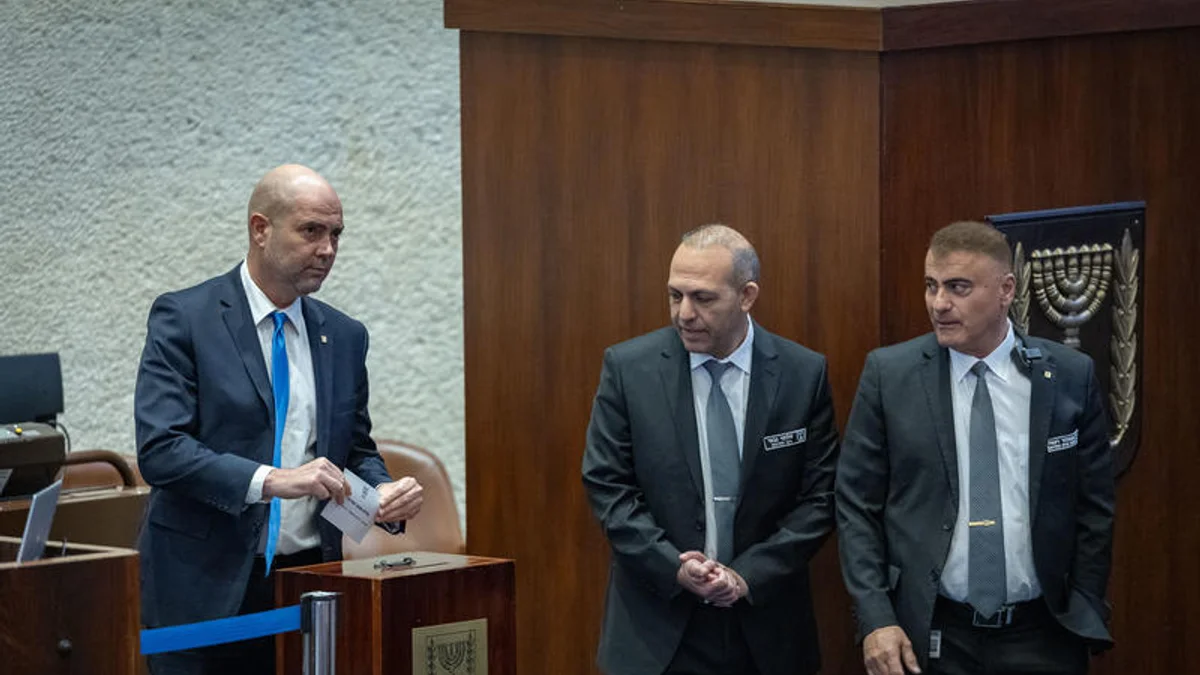
Within the change bloc, a broad consensus emerges regarding a step executable prior to resolving government formation: replacing Knesset Speaker Amir Ohana. The move aims to grant the anti-Netanyahu camp control over the parliamentary agenda, even if Netanyahu continues serving atop a transitional government. Electing the Knesset speaker constitutes one of the initial moves in the new Knesset, with the vote conducted openly. To replace Ohana, the change bloc must forge a majority around an agreed candidate, potentially relying on votes from Arab party Knesset members. The move does not mandate prior agreement on the composition of the next government.
Among candidates whose names surfaced for the position are Chili Tropper, Matan Kahana, and Elazar Stern from Eisenkot's list; Meirav Ben Ari and Eitan Ginzburg from the Bennett-Lapid list; Efrat Rayten from The Democrats; and Adv. Oded Forer from Yisrael Beytenu. An agreed candidate remains unannounced. Lieberman estimated this week that Knesset members from the outgoing coalition will likewise support Ohana's replacement, estimating that roughly one-third might vote against him. Should such Knesset members materialize, they must execute this publicly.
The change bloc seeks to advance a state commission of inquiry into the October 7 events, legislative changes in conscription, term limits for the prime minister, and the reversal of judicial changes promoted by the outgoing government. Lieberman additionally seeks to advance legislation preventing a criminal defendant from serving as prime minister. Mandatory agreement across all legislative details and prioritization remains unreached among the parties.
Teams representing the parties have already held meetings to coordinate initial steps in the new Knesset. The idea exploits the initial weeks post-election, prior to coalition negotiations deepening mutual disputes. The backdrop features the lesson learned from the Bennett-Lapid government: promised legislation during its inception remained incomplete before its collapse. This time, the change bloc intends to advance moves swiftly, yet apprehension persists that Knesset members holding divergent views will fail to support every clause on the shared agenda.
Replacing the Knesset speaker does not automatically grant a majority for legislation, nor do all change bloc members agree on every legal amendment. Legislation functionally targeting Netanyahu anticipates constitutional and legal difficulties, including applicability and personal legislation questions. A state commission of inquiry likewise does not materialize automatically simply because the Knesset elected a new speaker. Should the move succeed, Netanyahu may continue serving as transitional prime minister while a new Knesset, where opponents hold a majority, pursues an agenda opposing his government.