Stein reminded the government: there are limits even during an election period
Supreme Court Justice Alex Stein's decision to freeze questionable fund transfers to ultra-Orthodox and settlers highlights the balance between governance and the abuse of state resources during elections.
- The decision of Supreme Court Justice Alex Stein to freeze questionable fund transfers to the ultra-Orthodox and settlers while maintaining the "civilian emergency transfer" expresses the balance between what is permitted and what is forbidden during an election period. On one hand, there is no restriction on the government to continue functioning as usual, and on the other hand, it must refrain from abusing state resources during the outgoing government's term so as not to set facts on the ground for the next government, especially in the areas of appointments and budgets.
The waiting period until the Likud primaries and likely after them is expected to be challenging for the state and democracy. This period will test the limits of restraint of ministers and MKs regarding the trampling of democratic values, proper administration, theft of appointments and dismissals, looting of the state treasury, and more. It is not about limits of restraint here, but about the opposite limits of "it's not done."
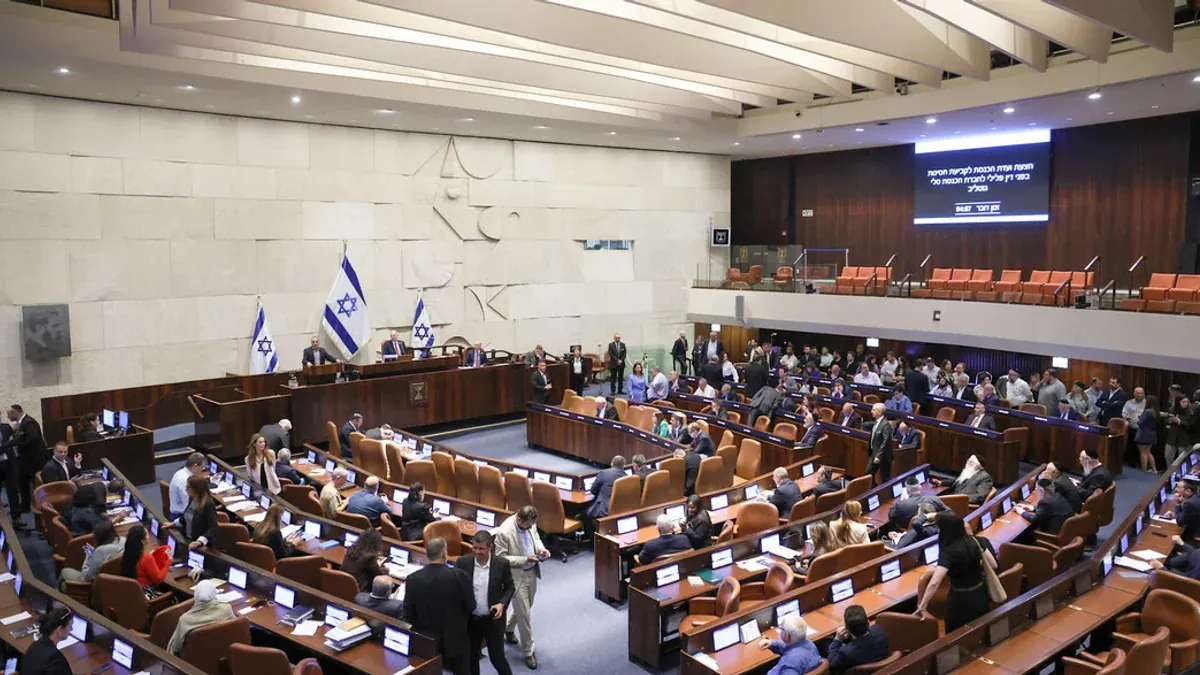
After the "horror show" of Defense Minister Israel Katz on Channel 14 and the "charming smile" video, we received another horror show from the chairman of the Finance Committee, Hanoch Milwidsky. Milwidsky, who shares the credit for "it's not done" here with Knesset Speaker Amir Ohana, convened the Finance Committee to transfer hundreds of millions of shekels, coalition funds, to the ultra-Orthodox and settlers less than 90 days before the elections. Funds that were hidden within seemingly legitimate transfers. Convening the discussion without the opposition's consent was made possible by exercising the rare authority of Speaker Ohana to order such a discussion without reporting, reasoning, or presenting a legal opinion.
Opposition MKs petitioned the High Court of Justice through attorney Yifat Solel with an urgent request for an injunction against convening the Finance Committee or, alternatively, an interim order that would prevent the transfer of funds. How much will the High Court intervene? It depends on the question of how far it will go in applying the laws of restraint before elections to a government that has already proven its willingness to trample every democratic and legal tradition. Meanwhile, the decision of the (conservative!) Justice Stein is in a positive direction. He issued a temporary order delaying the budgetary transfers, except for those concerning civilian emergency expenses. In simple terms - what is necessary, is necessary, and what is not - is not.
The main restrictions on the government in the period before elections are found in the rules of administrative law, in High Court rulings, and in the guidelines of the Attorney General. All the normative sources that the current government and its ministers enjoy trampling at every opportunity. Regarding the government, the Supreme Court determined that the powers of a government during an election period are identical to the powers of a normal government. And yet, it must act with restraint and caution and only subject to a vital need for action. As the election period approaches, the range of reasonableness for actions that deviate from what is strictly necessary narrows.
Regarding the Knesset - during election recesses, it is customary to establish a "consensus committee," in which coalition and opposition representatives are members, and it approves each committee meeting individually. The mechanism is intended primarily to complete essential legislation agreed upon by most parts of the house that was already in the legislative process. The idea is to prevent the Knesset and its committees from conducting political propaganda. According to former Knesset legal advisor Eyal Yinon, it is about "preventing the transformation of Knesset discussions into an arena for election propaganda, and the desire to avoid 'election legislation' and the use of parliamentary tools for the purpose of promoting narrow political interests."
- The internal court of the Likud canceled this week a decision of the Likud center to change the rules of selection and its prospects in the primaries. The center adopted and approved a proposal by Prime Minister Benjamin Netanyahu and Likud center chairman Minister Haim Katz that would allow incumbent ministers and MKs to run in districts for a place on the Knesset list. The districts are the stages on which new faces emerge. Netanyahu and Katz sought to expropriate them as compensation for the incumbents, in return for satisfying Netanyahu's intense desire for "reserved spots" (appointments) that reduce their chances of being elected.
Katz, the partner in the scheme, met Netanyahu based on his interest - to ensure the election of Knesset members Kati Shitrit and Eti Atiya, two women whose absence from the Knesset the people of Israel would find difficult to contain. The political story is interesting, but alongside it, the legal lesson is also important. Here, the judges of the Likud are canceling a decision of the elected officials! And furthermore - of the Prime Minister! Try to imagine and transfer this situation to the High Court field - the Supreme Court cancels a law or decision of the Knesset or the government and the Prime Minister. What a hail of insults and incitement to disobedience we would hear from the politicians. Activism, illegal invasion, theft of governance, harm to the will of the people, and all that jazz.
And that is exactly what happened inside the Likud, which cut out half of the scheme. Netanyahu got his reserved spots, but the incumbent ministers and MKs will not be compensated with the possibility of being elected in the districts. If the Likud receives, as expected in the polls, 23 mandates, six of them are Netanyahu's reserved spots in addition to Netanyahu himself. That means only 16 will be elected in the primaries, and that means about half of the current incumbents are going home. And if they had run in the districts? Even then they would have gone home because the highest-ranking district representative - Shfela, Jerusalem, and Judea and Samaria - is only in the 27th place on the list. And now stay all of you with bated breath - are Kati Shitrit and Eti Atiya in or out?