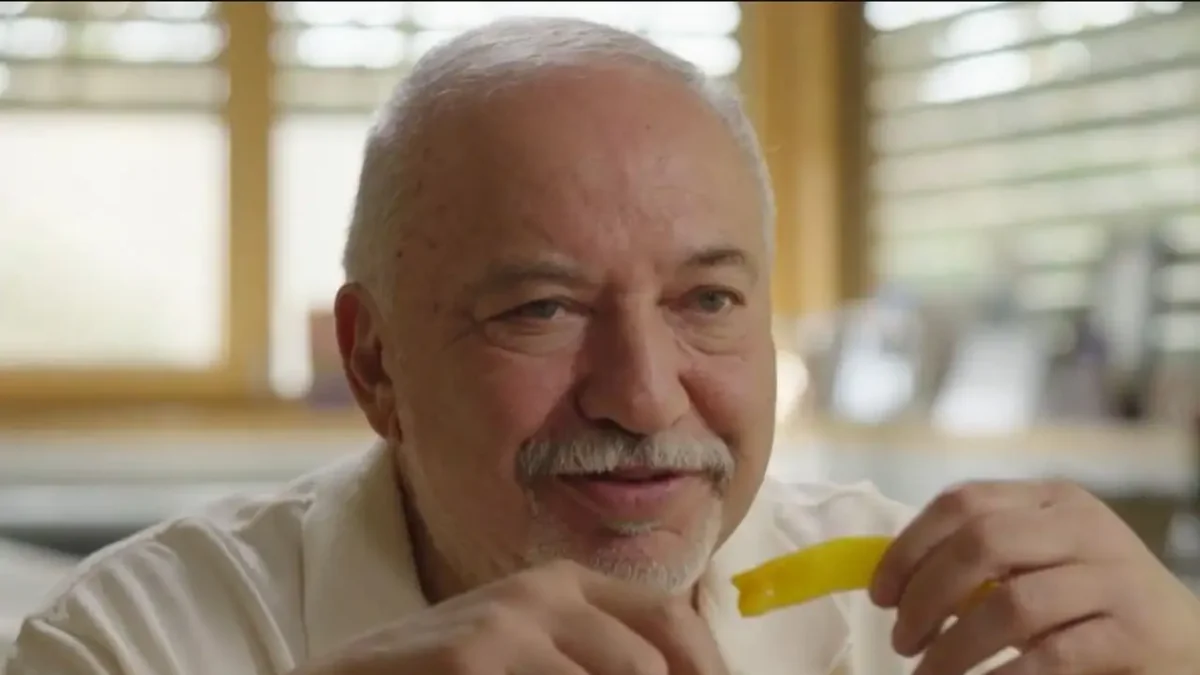
Ra'am in a Clear Day: The Challenge of Yoav Segalovitz
Yoav Segalovitz of Yesh Atid and Mansour Abbas of Ra'am are forming a political alliance that could alter the election landscape. This move challenges long-standing paradigms regarding the participation of Arab parties in government.
The seating arrangement in the Knesset plenum hall mandated that Yoav Segalovitz of the Yesh Atid faction sit behind Mansour Abbas of Ra'am. The chairs of Ram Ben-Barak and Elazar Stern, Segalovitz's faction colleagues, are adjacent to the two. It turned out that Abbas was surrounded by senior security establishment figures: one, a deputy head of the Mossad; the second, an IDF major general; the third, a police superintendent. Abbas was not pressured: he has an unpressurable temperament. He used the long days of tedious debates in the plenum to make friends for himself.
Stern and Ben-Barak were witnesses to the alliance that was gradually forming between Segalovitz and Abbas. Stern, who is likely to move soon from Yesh Atid to Eizenkot's party, encouraged the alliance wholeheartedly. When we published in the newspaper on Friday that Segalovitz had decided to join Ra'am, Stern was the first to call Segalovitz to congratulate him. Since then, Segalovitz's phone has not stopped ringing. His family vacation in Thailand was drowned in calls. I assumed people would call, but I did not assume how many, and with what enthusiasm. It turns out that many people were hoping for this news, for a bridge to be built between the Jewish political center and the Arab center, despite the boycott imposed by most party leaders in the 'change bloc', or perhaps because of that boycott.
Tomorrow, Segalovitz returns to the country. In the coming days, Abbas will have to do what is required to legitimize the alliance. Ra'am will need not only to make room at its top for a Jewish and Zionist politician — it will need to change. Do not be misled by Abbas's relaxed rotundity, by the moderation of his language — he is a true revolutionary. The addition of Segalovitz is part of a broad, far-reaching vision. A rare example in our political system. There is no consensus on Abbas in Arab society, but there is on Segalovitz. Politicians from among Abbas's rivals whom I spoke with yesterday criticize him harshly — but regarding Segalovitz and his contribution to Arab society, they are careful to say only good things.
Segalovitz served as Deputy Minister of Public Security for only a year and a half. His example is rare in our political system, perhaps one-time: he acted to curb crime in the sector without expecting any return at the ballot box. To his surprise, he became an asset, both in Arab society and in Jewish society. His courage is appreciated, as is his willingness to tear a door in the wall, to act outside the box, to change. It is possible that the move will go wrong, it is possible that it will dissipate under the pressure of other events. There is no certainty, but the potential is great. It extends beyond politics, beyond elections. Segalovitz and Abbas seek to break a paradigm, to refute an assumption that has become an indisputable convention: Arabs cannot be partners in government. It is not their opinions that disqualify them, nor their political demands. They are disqualified because they are Arabs. The explanation is October 7: it is reasoned not by what the Arabs did then and later, but by the trauma the Jews experienced. The language is racist but the motive is practical: disqualifying the Arabs artificially shrinks the 'change bloc'. It turns a stable majority in the polls into an 'almost majority'. Apparently, it is the only chance for the Netanyahu bloc to win the election.
Bennett, Lapid, and Lieberman join the disqualification because they were convinced that there are floating votes in the soft right that could decide the election results, and for these voters, the inclusion of Ra'am is a red line. Perhaps. Yesterday, I asked the spokesperson for the 'Together' list for a response regarding the connection between Abbas and Segalovitz. After a discussion, they preferred not to respond officially, only to say, unofficially, that it might play into the hands of the Likud and jeopardize the bloc's victory in the election. Segalovitz acted on his own accord, they emphasized, not on Lapid's.
Challenging the perception of left and right
Segalovitz's joining challenges not only the perception of Jews versus Arabs — but also the perception of left and right. Apparently, Ra'am is positioned to the left of the Democrats: that is the image. But religiously, socially, and culturally, Ra'am is right-wing. In terms of the conflict, it is on the left, but the Meretz people in the Democrats are much more leftist than it is. Assuming the connection materializes, it may affect the elections in several ways. The competition between the two lists in Arab society will intensify. Mayors and heads of authorities, who traditionally supported Hadash, will recalculate. They will want to influence the next government. Their joining will bring to the list voters and 'vote contractors' who until now acted only in local politics, the political arena that Arab society focuses on. Abbas believes that the turnout in the sector will rise from 52 percent to 60 or more. Something may also happen in Jewish society: Ra'am may receive up to a mandate from Jews, mainly at the expense of the Democrats. And here is a paradox: suppose Ra'am achieves a stellar, phenomenal success, and brings Hadash-Ta'al-Balad below the electoral threshold. Will that not jeopardize the campaign to remove the Netanyahu government? And another question: what will the crime families in Arab society do? Will they perceive the new connection as a threat? 'Pay attention,' a Knesset member from an Arab faction told me, 'in the last 21 days there was only one murder. Did the police suddenly wake up just to lull us to sleep on election day?' 'You are exaggerating,' I told him. 'You attribute excessive skills to the Israel Police.'