Deceiving the terrorists on the hidden route and the purge: "We passed tank after tank, without them seeing us"
In a spectacular journey to the summit of the Beaufort, Brigadier General Iftach Norkin reveals the daring combat maneuvers that broke the Hezbollah formations on the way to conquering the fortress that overlooks all of southern Lebanon. Dovi Eichenwald returns with Ron Ben-Yishai to the mountain that once again brings up the great missed opportunity of history.
The moment before the disaster
Exactly 44 years after I first climbed the Beaufort, in the midst of the First Lebanon War, I return to the fortress and its impressive cliffs and the breathtaking view overlooking the Litani, the Saluki, and Nabatieh. Tense and attentive to every rustle, I walk on this explosive ground during a fragile ceasefire. The Beaufort is part of my biography, sometimes suppressed and sometimes returning to me and reminding me of itself with a pinch.
In the First Lebanon War, I was drafted into the reserves as an officer in the Military Police. In June 1982, at the end of 60 days of service, I went out with some of my soldiers for a trip in the land of cedars. "We must reach the Beaufort and see Lebanon and Israel from it," I urged them as we climbed to the Crusader fortress, which is 717 meters above sea level. After we marveled at the view that reminded us of Switzerland, I was photographed with my two reserve friends - Staff Sergeant Yehoshua Zada and Staff Sergeant Yitzhak Gos. About four months later, on the morning of November 11, 1982, they were killed along with 74 other soldiers under the ruins of the government building in the city of Tyre, where we served. A suicide bomber exploded in a car bomb at the entrance to the building, which collapsed entirely. I was among the few who survived. Who would have believed that 44 years after that trip, I would find myself touring the Beaufort sector again.
The threat from the window in Metula
In the week before the trip, I met with Ephraim Sneh, who was the commander of the SLA (South Lebanon Area) in the early 80s and knew southern Lebanon and the Israeli connection with the Christians in the area well. He wrote a new book on the subject, "From Sidon to Hermon," and asked me to read it. "We were wrong when we relied on the Christians and on Bashir Gemayel, we did not understand the map and in fact, we failed in Lebanon," he concluded. After the meeting, he sent me a picture of himself from the Beaufort, with a Lebanese flag on it with his signatures and those of General Lahad, the commander of the SLA. "One day, when you conquer the Beaufort," he said in 1980 to General Lahad, when the fortress was still under PLO control, "this is the flag I would like to see flying there."
Sneh is a generation before me. When I was released from regular service in 1978, he was the commander of 669 and lived with his family in Metula. "Every morning, when I opened the window in my daughters' room, I saw the Beaufort. For years it was the symbol of the ongoing threat to our well-being and existence," he said. The meeting with Sneh, just a week before my visit to the Beaufort, was not perceived by me as a coincidence, but as part of the place this fortress occupies on the Israeli historical perspective continuum, a symbol of heroism and also a symbol of withdrawal.
The Beaufort contains so many layers: Goni Hernik, the commander of the Golani reconnaissance unit who was killed with five of his fighters in the battle for its conquest in the First Lebanon War, after replacing the wounded Moshe Kaplinski; Menachem Begin, who asked if they had machine guns; Ariel Sharon, who said there were no casualties in the battle; the Israeli flag raised over the Beaufort upon its conquest; soldiers spending their military service in the concrete post deep underground; soldiers fighting in the security zone to remove the threat over Metula and the Finger of the Galilee, many of whom paid for it with their lives; the helicopter disaster, in which 73 fighters were killed on their way, among other things, to the Beaufort, which was the basis for the establishment of the "Four Mothers" organization, which demanded a withdrawal from southern Lebanon until it finally happened.
A strategic dominant point
When the Beaufort returned to our lives, again, I wanted to return to that ancient Crusader fortress. Around me were attempts to persuade me to give up the idea: you are 70, calm down, it's dangerous there, the area is infested with Hezbollah terrorists and explosive drones, why are you provoking death, but I insisted on being there and asked my friend Ron Ben-Yishai to accompany me. On the way, four-thirty in the morning, the roads are empty, the silence around transmits tranquility and pastoralism despite the commentators' prophecies about a combative weekend with Iran, I asked Ron what the Beaufort is for him.
"The Beaufort has no emotional importance for me, although I accompanied Ariel Sharon throughout the Lebanon War. I didn't fight there, I wasn't a witness to the battles at the Beaufort, for me it is a strategic dominant point. Look, even the PLO didn't fortify itself on the Beaufort, but outside it. The post and the tunnels were built at its foot. The Beaufort was always guarded. As its name suggests, 'Beaufort' (beautiful fortress), it is indeed a beautiful fortress that overlooks a spectacular view. I am going to our visit very intrigued, and mainly want to hear how they conquered the Beaufort, because after all, Hezbollah is not the PLO and the battle was very challenging and difficult."
From Norkin I understand that we have learned how to defend ourselves better against the drone threat, and indeed, the number of our casualties has decreased significantly. From the things I conclude that we have received an opportunity for a rare glimpse into the future combat map, but the Beaufort is not just a point on the map. The experiences, the traumas, the mental wounds, the families who lost their loved ones, all these sit with me in the car on the way to it. When I told Major General (res.) Moshe Kaplinski about my visit to the Beaufort, he immediately said: "I envy you. I would very much like to reach the fortress, but unfortunately, I am not allowed as a civilian to go up. The Beaufort is a piece of life for me." Kaplinski, like many others, has his own Beaufort. Unlike the rational Ron, I am emotionally overwhelmed. Throughout the trip, my last picture with my two reserve friends at the Beaufort in 1982 runs through my head. The three of us are young, full of life and plans, not imagining the terrible event that fate will summon for us not long after. I asked myself what is the source of my longing to return to this complex place. It is clear to me that it is not about closing a circle. The circle for me is missing two of my friends, and therefore cannot be closed. If I can ever reach Tyre, when I lay flowers at the place where my friends were killed in the attack on the government building, it will be a closing of a circle.
"I want a battle without casualties"
I didn't imagine I would ever return to the Beaufort, certainly I didn't imagine a journey in which we are accompanied by Brigadier General Iftach Norkin, commander of the 36th Division who led the conquest of the Beaufort in May 2026. I received the message from the IDF Spokesperson during a tour of the Ramon base, in the F16I squadron, together with Major General (res.) Amikam Norkin, former Air Force commander. Surprised, I asked Amikam if he had a connection to Brigadier General Norkin and he replied with the utmost naturalness: "Indeed, cousins." His father and Iftach's father are brothers. Again the coincidence raised its head.
37-year-old squadron commander tells me about leading a formation of dozens of attack aircraft to Iran almost every day and night, about the dedication to the mission, about the sense of mission, about the long hours in the air and about sitting in the narrow cockpit (they let me try, and I admit that sitting for just a few minutes is far from comfortable). The things I heard from him and his subordinates filled me with strength and hope. With such a generation, no one will be able to overcome us. The roots of Zionism are embodied in the Norkin family tree. Amikam, a moshavnik from Beit Shearim in the Jezreel Valley, who studied at the agricultural school in Nahalal, tells me about his grandfather on his mother's side, who was one of the founders of Nahalal, and about his grandfather on his father's side, who was one of the founders of the Hashomer Association together with Alexander Zaid. He himself is named after his father's cousin who was killed by a Syrian mine in 1966. Iftach Norkin was also born in Moshav Beit Shearim in January 1981, about a year and a half before the Lebanon War.
We meet at the Bnia lookout, on the border with Lebanon, and set out. Instead of breathing dust in open Hummers, we pampered ourselves in closed Hilux vehicles. For an hour and a half, we drove about five kilometers, in the thicket. We advanced slowly on winding paths in the dense vegetation, and as we climbed, the landscape became more breathtaking. The smell of war is still in the air. My memory of the trip to the Beaufort was an paved road that led me and my two soldiers from inside Lebanon, through Tyre and Nabatieh. The Beaufort post then included a large complex of fortifications and a battalion defending the place. Today there is no post there, Hezbollah terrorists hide in tunnels spread underground, but somehow I didn't feel fear. Brigadier General Norkin radiated confidence, identified every fraction of movement in the space, knew the terrain in detail, and yet, it seemed to me that the silence around us was tense. Brigadier General Norkin drives, his gaze constantly examining the environment, announcing the next turn. I swallow the cliffs that were etched in my memory, the landscape overlooking the Litani flowing calmly reminds me of the Jordan. Nature may not change, but I am no longer the same person I was four decades ago. I have gone through a life path of family, of books, of memories, and like me, history is not frozen in time - it moves with us along the twists of life.
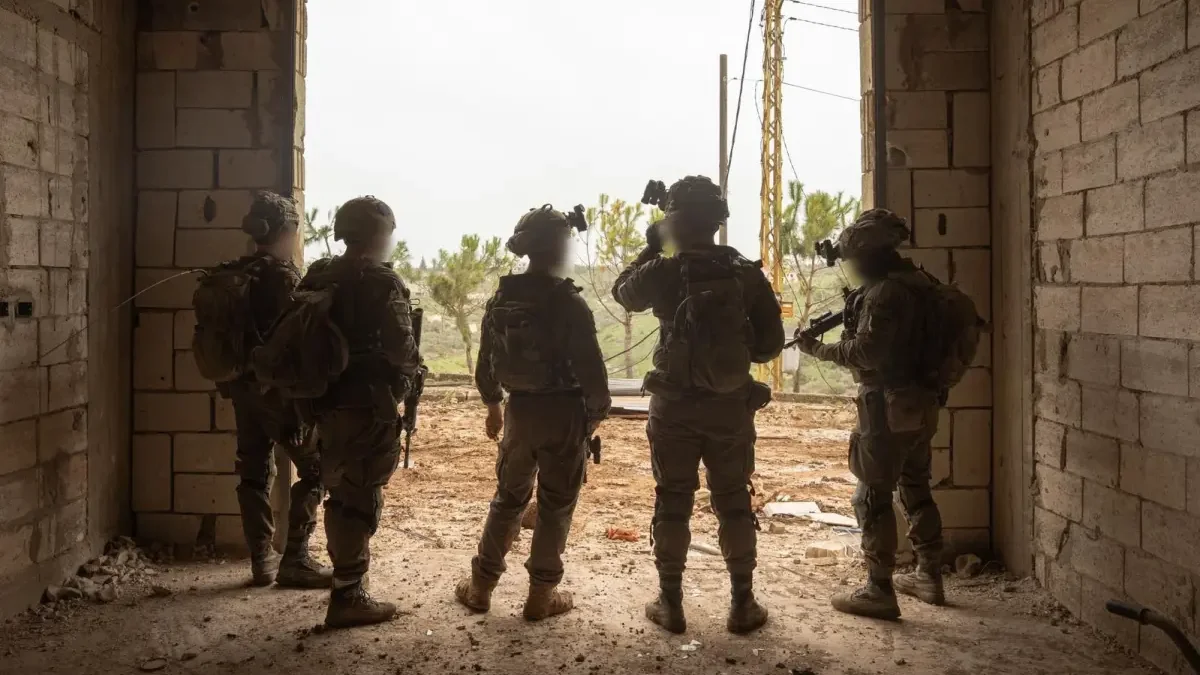
An impressive officer, Iftach Norkin. Businesslike and balanced, he describes the meticulous planning of Operation "Mountain Heights" that he and his fighters carried out in May of this year. The name is taken from the prophecy of Isaiah: "With the multitude of my chariots I have ascended to the height of the mountains, to the edges of Lebanon." Despite his request to mention his name as little as possible, it is impossible to ignore the military capabilities, the courage, the creativity, the tricks and the diversionary actions he demonstrated, thanks to which surprising paths were broken for the forces to reach the fortress, and the very impressive achievements of the fighters. Brigadier General Norkin took the Golani reconnaissance unit to Qalaat Nimrod, and there models of the fighting on the Beaufort were built. "I want a battle without casualties," he kept saying to the soldiers and commanders, and it was clear that he was referring to the First Lebanon War and the heavy price the reconnaissance unit paid then. Now, as we travel on the same paths that the fighters walked, roads that Hezbollah commanders did not imagine could be moved on, he reconstructs the conquest for us. I try to describe what the IDF soldiers who walked on foot in the muddy ground went through, without knowing where the terrorist who would fire bursts at them would pop up, and I tell myself again and again that this is a generation of heroes.
With tricks you will make yourself an operation
We stood on the summit of the Beaufort. To my right Ron Ben-Yishai, to my left Brigadier General Norkin and the division chief of staff Brigadier General Mordechai Kahana. Only when you are physically in the field do you understand the wonderful and complicated work that the fighting forces did there. Whether in building bridges, sophisticated Hezbollah diversions in particularly challenging terrain, or in dealing with the drone danger. When I shared my reflections with Brigadier General Norkin, he ruled: "I don't deal with honor. We are people of action," and signed off the discussion.
Hezbollah, especially after the Second Lebanon War and after the withdrawal in 2000, organized itself so that the IDF would no longer cross the Litani to the north. Now Brigadier General Norkin explains how they did it despite everything. In the first stage, he says, they started fighting for the village of Taybeh, which was an important case study because it was fully controlled by the Radwan force. There were very difficult battles. Between the north of the Litani and the Saluki ridge is a kind of bathtub that the division fought in for long months. The Golani battle on a winter night, without air support, was intended to allow the 98th Division to descend to the Litani and raid the Beaufort. Following the difficult battle, the Northern Command Chief Rafi Milo makes a brilliant decision to stop the operation, bring in the 36th Division as well, and plan again. It was clear that the Beaufort threatening Metula had to be conquered, and then the stage of preparing the conditions began. Hezbollah is a guerrilla organization that operates in small cells of intelligence gathering and fire. If you work incorrectly, even a small cell can stop a brigade, explains Brigadier General Norkin. Therefore, the forces started by clearing the Litani thicket of terrorists, mainly on the southern bank. "We worked for two weeks to open a completely new route in Wadi al-Man," he emphasizes. Hezbollah did not believe that the IDF would succeed in crossing the thicket at this point, so they did not prepare properly. "When they fired at us from the direction of Faroun," he continues, "the Golani brigade commander suggested that we do a deception as if we were going to the Saluki. I took the 12th Battalion of Golani and the 7th Brigade and for a week we broke through a hidden route. We crossed tank after tank, D9 after D9, without a route and without them seeing us. In the morning the tanks were on the Litani. It took a week to scan the entire Litani and clear it of terrorists. I understand that when I build a route from above, they can reach me from the flanks," he recalls, "and then the Golani and Egoz reconnaissance units do an extraordinary operation, in which 20 terrorists are killed. It is clear to me that an entire division that will conquer two routes is too dangerous, and I want Golani to conquer the Beaufort and emphasize that it will be without casualties."
A complex operation that is hard to describe the courage, creativity, and giving of the fighters. Brigadier General Norkin describes the operation to Ron and me as if it happened a minute ago, dwells on the nine wounded and the evacuations during it, goes down to the details of hitting a vehicle in the Hezbollah Shaqif sector. Ron, who knows every wadi, asks questions, and Norkin explains patiently. Again and again, his words raise the heroism, the daring, the military trickery with which he led the division on a path that was a complete surprise to the enemy. And I think to myself that this battle, this operation, which was swallowed up in the public consciousness because we were all busy at that time with Iran, will yet be studied as one of the greatest battles in history in warfare schools around the world.
Dealing with the drone threat
On our way to the Beaufort, we saw how Hezbollah prepared for fighting against us, including underground infrastructures we were not aware of. We drive and see tunnel openings that were bombed by the Air Force and still exist. This tunnel network arouses frustration. I remind myself that this is history and this is Zionism. Norkin's grandparents came here to establish a state. The Air Force that cousin Norkin prepared attacks in Isfahan, young Norkin conquers the Beaufort, and who knows what will fall on his children's shoulders. Now he explains to us about the drones that changed the battlefield and his combat concept. "We need to act so that they don't know where we are, and at the same time organize operationally to dismantle the threat," he says. From Norkin I understand that we have learned how to defend ourselves better against the drone threat, and indeed, the number of our casualties has decreased significantly. From the things I conclude that we have received an opportunity for a rare glimpse into the future combat map. In the past, it was the side charges that threatened us, and now the explosive drones. On one hand, dealing with an atomic bomb, and on the other - with drones on a metal wire. When I think about my grandchildren and great-grandchildren, who will have to deal with the same dangers, I have no sharp and decisive conclusion other than returning to the fact that my father's family was taken to Auschwitz because there was no one to protect them and no one to fight the Nazi evil.
Shlomo Artzi on loop
We part from Brigadier General Norkin and Brigadier General Kahana, who has been doing almost three years of reserve duty in a row, and continue with the driver, also a reservist, who returns us to the border. He says that on October 7 he finished a Golani reconnaissance course and how they dropped him and his friends in Ein HaShlosha without them even understanding what was happening around. Only four days later, when they opened phones, did they realize the magnitude of the event. Since then, until the end of his regular service, he fought in Gaza, went up to Lebanon, then to Syria and back to Gaza. When he was released, he went on the big trip: four months in South America. At 22, he returned straight to Lebanon by Order 8. He doesn't complain, speaks with pride about the service, but is eagerly waiting for his first academic year in economics and philosophy departments. I listen, proud of him, and yet worried. His generation has gone through things in the last three years that are hard to fully understand. I asked him what to do when the memories of the war come up, bother and don't let go, and he replied: "I listen to Shlomo Artzi on loop."
A regular officer in Golani serving in Lebanon wrote on the eve of Tisha B'Av: "I and my department have been inside for 22 days, in Lebanon, and the exit is only on the distant horizon. We sit on the most forward line, 15 km from the border and continue to destroy enemy infrastructure in the area. And it is very not easy. The battalion has been maneuvering continuously for more than four months, and the fighters are worn out... very challenging physical conditions and a difficult mental feeling... From the summit of the Beaufort, I look with longing eyes at the convoy of Lebanese army vehicles. When we passed the Litani, I imagined the peace agreement, the people of Israel traveling in the Litani and its surroundings, coffee carts in every corner, families picnicking, children climbing the high mountains. Switzerland is here, next to the house. "But yes, it seems to me that the public has forgotten a bit. Forgotten that the war is not over yet, that there are still thousands of heroic fighters who continue to fight deep in enemy territory in Gaza and Lebanon, who are no longer interested in a superficial and shallow election video. We are interested in returning home safely, we are interested in preserving this gift called the State of Israel, which from the inside feels so taken for granted, but when you look at it backwards, from the depth of Lebanon, you understand how much it is a miracle that can disappear at any moment. So precisely now remember us, the fighters at the front. Because from here, from Lebanon, it is really clear that we have no other country."
The officer's words reminded me of one of the passages from the book "If There Is a Paradise" by Ron Leshem, which I read again all night in preparation for the visit. The Beaufort that Leshem described, which was also adapted into a wonderful film, "Beaufort," tells the story of the fighters at the post in 1999-2000. A Beaufort of daily fear and horror. And here is a conversation between the narrator and his friends: "'So why are you here?', I asked. They were silent. 'Answer me', I screamed. "'The country is betraying us', Boaz burst out, nervous, 'we are here and no one else moves their ass to get radiators when we are freezing from the cold, and no one takes care of us with supplies on time, and no one bothers to bring us water when the tanks run out, and they don't stop us for rides when we stand at the Kiryat-Shmona junction, so for whom are we doing this? We are no longer appreciated in the country'". So what has actually changed? I wondered. Not much. I am the one who changed, I am no longer that 27-year-old reservist. Every time a new generation bears the responsibility and commitment to protect the home. The fortress is not the story, the story is about us - a people that sends its sons again and again to the same places so that its children can live here in safety.
The eyes of southern Lebanon
Standing there, on the Beaufort, stunned and full of admiration for the reconstruction of the battles we heard, I looked at the rocky fortress that ironically, and perhaps even a bit cynically, was declared about two weeks ago by UNESCO as a World Heritage Site. I thought about the fact that we are getting old and the fortress remains exactly as I remember it, standing on its foundation, dominating the topography and its land saturated with blood. When you watch from there on Metula, you feel the houses of the Israelis in the palm of your hand, and the understanding of how easy it is to kill them is shaking. Now, with the re-conquest, in Metula and Misgav Am they breathe differently and the area is a bit safer.
When we look at southern Lebanon from the Beaufort, I remember that in the book the soldiers called the fortress "The eyes of southern Lebanon." I think about the commander's opening sentence to the soldiers, facing the first sunrise in the Lebanese landscape revealed to them: "If there is a paradise, it looks like this, if there is a hell, it feels like this. Beaufort post." Today there is no post, it was blown up before our withdrawal from Lebanon and was not rebuilt. Leshem describes in the book Operation "Walls of Hope," the fortification operation of the post: "Dozens of concrete trucks climbed to the post, construction units raised fences, stretched huge nets in front of the positions - nets that touching the missile will initiate the explosive mechanism in flight and the explosion will occur in the air, at some distance from the ground, so that it will reduce the impact force. They built huge concrete walls, also secret electronic jamming devices were installed."
I tried to imagine the piles of concrete and the digging at the foot of the Beaufort, and at the same time, after years, the explosion of all this construction. And today, when there is no post, what do we do? If we stay here, will they start building wire nets again? Tons of concrete will be poured again into the ground? To myself, I wonder what will happen if they force us to withdraw from the Beaufort and Hezbollah will again sit closest to Metula and our great-grandchildren will also have to fight for the Beaufort. From the heights of my years and experience, I want to hope that the Lebanese army will indeed succeed in making some order in the bleeding country and in the Hezbollah thicket, and the fighting for the Beaufort will not repeat itself. Again. We must be strong, Norkin's voice echoes in me on the way back, and with it the picture of the Lebanese army vehicle convoy with the UN vehicles that I saw from the summit of the Beaufort. I looked at it with longing eyes. Maybe after all some arrangement is being woven with Lebanon. When we passed the Litani, I imagined this peace agreement. I could see the people of Israel in their masses traveling in the Litani and its surroundings, coffee carts in every corner, families picnicking, children climbing the high mountains and being exposed to the amazing landscape around. Switzerland is here, next to the house. It looks so normal and sane. Maybe after all there is an option for paradise here? What a missed opportunity of history, I say to Ron Ben-Yishai, and we both nod.