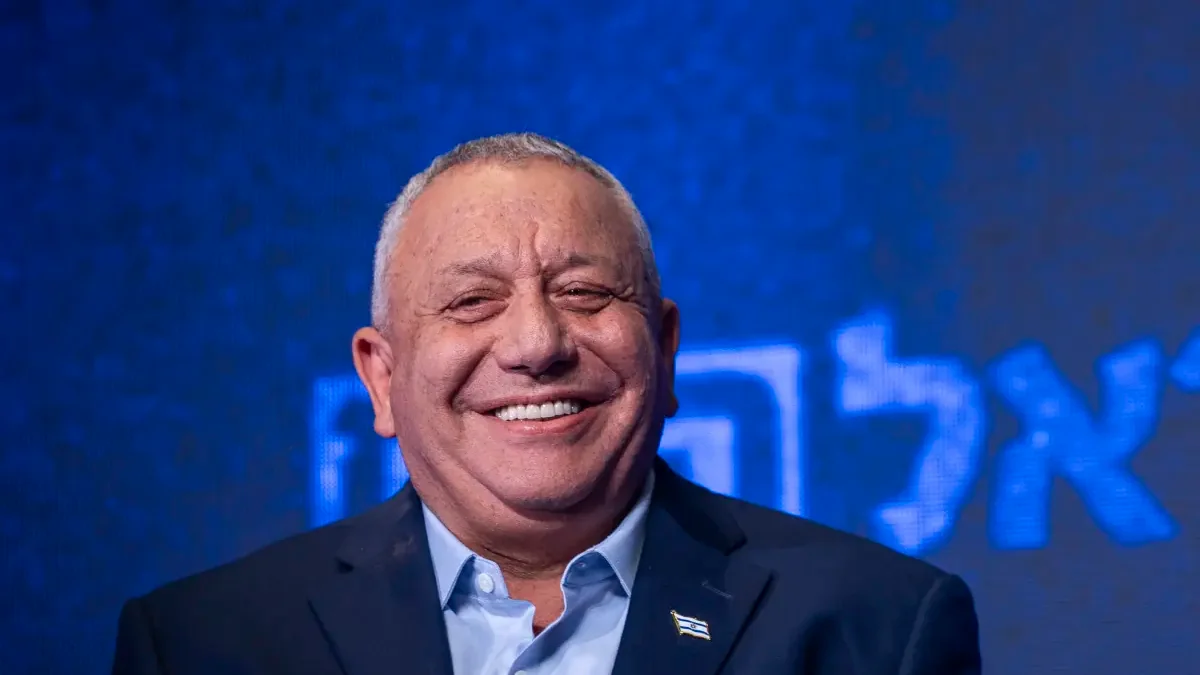
Gantz at the security conference: "Netanyahu is a better politician than I am"
Blue and White party chairman Benny Gantz, in an interview on Channel 14, discussed his complex relationship with Prime Minister Benjamin Netanyahu and the management of the war. Gantz praised Netanyahu as a "better politician" and a capable wartime leader, while also accepting his share of responsibility for the failures leading up to October 7.
Chairman of the Blue and White party, Benny Gantz, addressed today, Tuesday, in an interview at the 14th Channel's security conference the complex relationship with Prime Minister Benjamin Netanyahu and the management of the military campaign. Gantz chose to compliment his political rival:
"Netanyahu is a better politician than I am. From a military perspective, he is managing the war well."
Gantz added that "my relative advantage as a statesman is not to approve the operational plan for him, but to bring him the resources and the political conditions he needs in terms of backing."
During the interview, Gantz was asked about his personal responsibility for the events of October 7, and he responded with sharp self-criticism. While calling for the establishment of a state commission of inquiry, Gantz, who served as Chief of Staff and Minister of Defense for years, admitted that he sees himself as part of the system that failed over time. "I am not running away from responsibility," he clarified. "I was a partner for 7 years that allowed this to happen. I was part of the system that built the concept and allowed these processes to develop. I need to explain seven years – that is what I want us to check."
Gantz defined the Simchat Torah massacre as a "very big failure" and emphasized that Israel must draw strategic lessons for the future. He called on Israel to adopt an initiative-based security concept: "We will have to initiate military campaigns. It is not about using a situation to react, but to initiate. This is something that did not exist in our concept at the level of 'the necessity of fighting' when nothing had happened yet, and this must change." Gantz detailed his plan known as "10 to the fifth," according to which within a range of 10 km from all the country's borders, and with an emphasis on the Gaza Strip, the formation of a terror army will not be allowed.
Kibbutz Re'im, after the October 7 massacre | Photo, archive: Yossi Zamir, Flash 90
Regarding his resignation from the government and the cabinet, Gantz claimed that the facts do not support the claim that he delayed the campaign. "I demanded to enter Rafah and Khan Yunis earlier, contrary to what the Prime Minister said. I wanted Lebanon earlier," he said. He further added that the resignation came after weeks of attempts to reach agreements on six strategic clauses with Netanyahu, who, according to him, "pushed them away all the time."
When asked about the performance of Minister of National Security Itamar Ben Gvir, Gantz chose to note that the minister "perhaps did something good in the Prison Service," referring to the improvement in the system's functioning regarding security prisoners. However, he added a jab: "I do not see any great successes there in any other field under his responsibility." Gantz expressed reservations about sitting together with Ben Gvir in a future government due to "serious things he did in the past," but noted that regarding Minister Smotrich, the picture is more complex.
In conclusion, Gantz outlined his political vision and emphasized that he aspires to establish a broad unity government that crosses blocs. "I am not willing to settle for a narrow government for any side," he declared. "I joined the emergency government despite Netanyahu and for the sake of the State of Israel. My agenda is one: that there will be a government here on the broadest possible basis from both sides. I do not hate anyone there and I want to save the country."