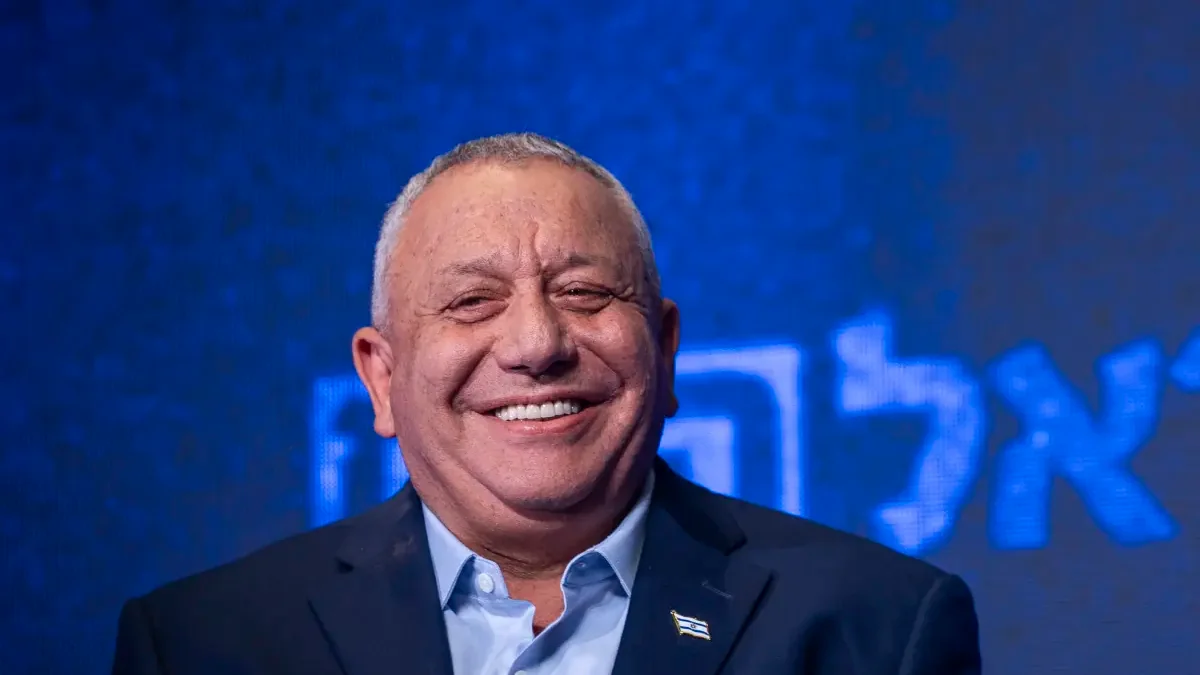
Facing Golan
The Democrats party could be the second largest in the change bloc if Bennett and Lapid split after the elections. Its members do not hide their desire to promote the idea of a Palestinian state. But this is exactly what could keep the undecided from the Religious Zionist sector in the embrace of Netanyahu and the Haredim.
'These are fairy tales from the school of the poison machine, I do not relate to this, one can see that there is no change in the polling map, it is not my statement that changes reality.' So said the chairman of the Democrats, Yair Golan, in response to my question at the 'Yedioth Ahronoth' conference this week, regarding the claims of his opposition colleagues that his statements and the remarks of his party members are harming efforts to bring in the votes of coalition-disappointed voters who are debating whether to leave the Netanyahu bloc.
Golan, in my opinion, is wrong in his analysis. As of the writing of these lines, and in the absence of a clear decision between the blocs in the polls, there is no doubt that success in the upcoming elections passes through the mobilization of the undecided voters. According to a Mano Geva poll from Monday, about ten percent of the public is still undecided. Some of them are debating within the existing blocs, but there is no doubt that they are the main fertile ground for moving between camps and crowning the next government.
The main characteristic of the undecided: they are coalition-disappointed people who have had enough of Netanyahu both because of October 7 and because of the groveling before the Haredim. I live among my people. One of the sectors where the most voices are heard regarding the lack of a political home is Religious Zionism. The sector, not the party. Many reservists who have had enough of the Haredi rule.
Facing the undecided Religious Zionist is the dilemma - sending the Haredim to the opposition as many want, means a government in which the Democrats party wins a central place around the decision-making table. Netanyahu, Smotrich, and Ben Gvir are making an effort to scare the right-wing public from such a situation, both to encourage right-wing voters to go out and vote, and to deter the undecided from moving between the blocs. To Golan, they add Mansour Abbas, but the latter receives a fitting response from the leaders of the change bloc, since according to the polls they are a touch away from achieving the necessary majority even without him.
Contrary to Yair Golan's words, this is not another campaign of fear and delegitimization by his rivals. Unlike propaganda on other issues where the promoted messages create out of nothing the fears of the current demon, the fear of the undecided right-winger from Golan and the Democrats members is authentic. One of the reasons for this is precisely because of Golan's character, who refuses to adopt manners of friendliness, to moderate statements, or to spare his positions on controversial issues. Some will say that this is also the strategy of some of the Democrats members: just as there is a rise in populism on the right, there is also a rise in demand for such things on the left.
But it is not just about mere statements. Unlike the 'change government', when the effort to shrink Meretz and Labor by Bennett succeeded, this time it is clear to everyone that Golan and his friends are arriving at the coalition negotiations stronger. If you look at the polls, the Democrats may be the second largest party in the change bloc, since the 'Beyachad' party is a union of two lists that have a high probability of splitting after the elections and their power will decrease.
Golan does not hide his demands: he talks about the National Security, Education, and Justice portfolios, unlike the 'change government' in which Bennett managed to limit Horowitz and Michaeli to the Health and Transportation portfolios. In an interview this week, Golan told me that if he reaches 15 mandates, he believes he will be the Minister of Defense.
The central dilemma regarding Golan is not because of his threats to close Channel 14, cut the budget of the pre-military academy in Eli, and not even against the background of harsh statements against the 'hilltop youth'. It touches mainly on one issue: the issue of the Land of Israel and steps to establish a Palestinian state. Opposition to this issue is perhaps the last self-definition in which there is agreement across the entire right-wing spectrum from soft to hard.
Religious Zionism is one of the most divided sectors there is, from the subject of religion and state to the subject of amendments to the judicial system. But since the Gush Katif disengagement, on one issue there is almost complete unity of ranks - the issue of the Land of Israel and Judea and Samaria. Since October 7, other publics have moved to the right in their positions regarding these issues. Golan and his friends do not hide their desire not only to replace Netanyahu, but also to initiate politically on the Palestinian issue and promote separation steps. Eisenkot says publicly that he opposes a Palestinian state, but does condemn the steps of Smotrich in the area, which are considered mostly very popular even among his opponents within the sector. Golan told me this week in that same interview at the 'Yedioth Ahronoth' conference that Eisenkot understands perfectly well the need for separation steps from the Palestinians and that he believes he will succeed in convincing Bennett and Lieberman of this as well. It is highly doubtful if he will succeed, but doubt on such an issue is exactly what may return many of the undecided to Netanyahu's bosom.