Supreme Court and the Exemption from Arrest Law: Netanyahu's Political Trap
The law to cancel the arrest of Haredi draft dodgers has become an ideological and political burden. Prime Minister Benjamin Netanyahu is trapped between the need to maintain his coalition and the public demand for equality.
The law to cancel the arrest of Haredi draft dodgers is an ideological, social, legal, and political millstone. It is unacceptable for reasons we will discuss shortly, and it is also a political trap for Benjamin Netanyahu. The Prime Minister is falling here between the Haredim and those who serve. Between the need to bind the Haredim to him, who are essential for securing the continuation of his rule, and responding to the public sentiment that supports the needs of the army and equality in the burden.
This time, even a magician like Netanyahu manages to come out looking bad on both sides. Both the Haredim and those who serve do not believe him. Now, the Supreme Court remains, which can pull the chestnuts out of the fire for him: both to cancel the scandalous exemption and to partially save his image in the eyes of the Haredim—'Here, I did the maximum for you, it is the wicked ones from the Supreme Court who are harassing you.'
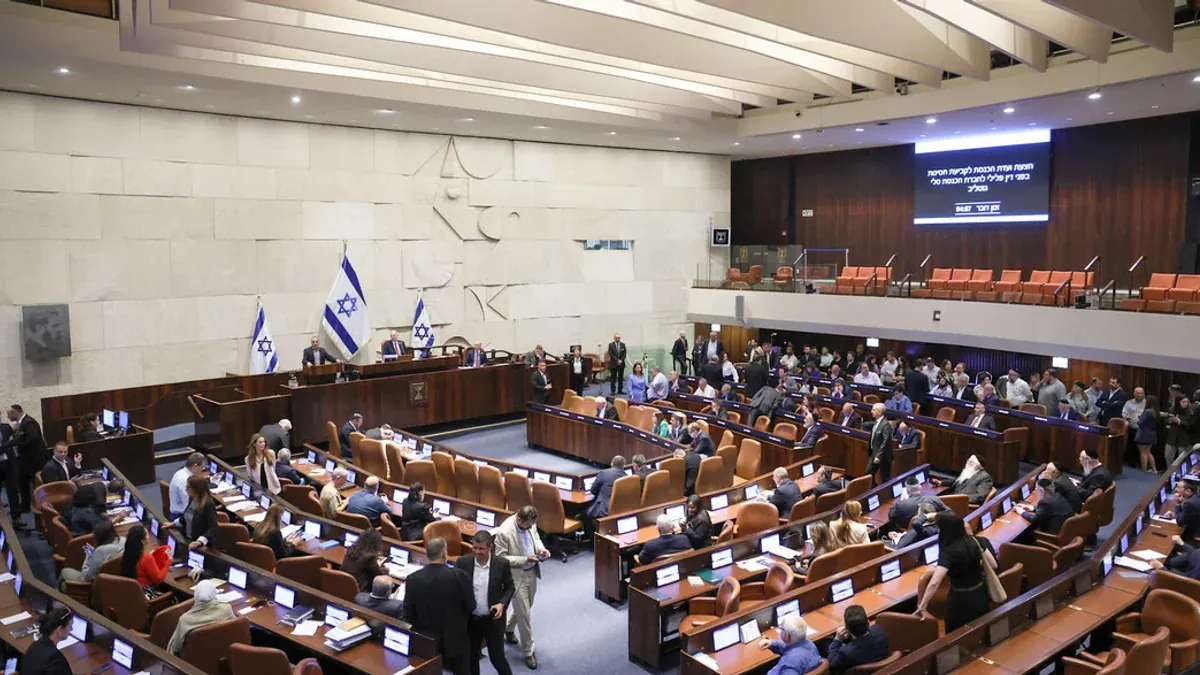
An expanded panel of nine judges will discuss five petitions to cancel the law tomorrow. Heading the panel is the Deputy President of the Supreme Court, Noam Sohlberg, who leads—both as a judge and as a man of Religious Zionism—the Supreme Court's approach against Haredi draft dodging. Sohlberg signed the verdict that detailed the economic-civil sanctions that should be imposed on the dodgers. And now, the law, whose official name is Amendment 28 to the Security Service Law, arrives at his doorstep.
Almost as usual, the paths of the state and the government diverge here. The state, through the Attorney General Gali Baharav-Miara, opposes the law, while the government supports it. But this time, it refuses to equip itself as usual with a private lawyer. It is better for it to push a written position to the judges than a lawyer who will be photographed while defending on its behalf an immoral and unconstitutional evasion. Such a lawyer would be excellent fuel for election campaigns, and it is better for Netanyahu to avoid that.
It seems easy to estimate this time—this law is doomed to be disqualified and canceled. It suffers from flaws in the legislative process, and above all, it stinks in its corrupted essence and content. As the Deputy Attorney General Gil Limon said: 'We do not know of a situation where the law gives immunity from criminal enforcement to people because of their civil activity.' As Attorney Miri Frankel Shor, legal advisor to the Foreign Affairs and Defense Committee, said: 'An arrangement that exempts a certain group from the duty to comply with the provisions of the law, without complementary mechanisms, violates the required balance and creates an arrangement that does not meet constitutional tests.'
The purpose of the law is not worthy. It contradicts the Basic Law: Human Dignity and Liberty, and it contradicts it twice: first, it is a direct cause of increasing the burden on those who serve; second, it creates a norm of selective and discriminatory criminal enforcement that contradicts the principle of equality before the law. Immediately after the enactment of the exemption from arrests, the Knesset extended by law the military service for June 2029 recruits from 30 to 32 months.
The new law tries to set a trap for the Chief of Staff Eyal Zamir and drag him against his will into the event. This is done by establishing a military committee to examine the conditions of the exemption and the question of who is a 'Yeshiva student.' Zamir strongly opposes this task, because it is impossible for the army to be signed at this time on mass exemptions, and because it does not have the professional tools to decide who is a 'Yeshiva student.'
In these discussions, the question always arises whether the arrests are effective. Their combination with economic sanctions teaches of a certain deterrence and recruitment numbers that are rising among the Haredim. On the other hand, the arrests have a unifying power in igniting Haredi resistance. Data shows that the Haredim are not the only ones suffering from the whip of enforcement. From the beginning of 2026 until June, 294 indictments were filed against those obligated to recruit who were declared draft dodgers, of which about 32 were Haredim. From January 2025 until May 2026, 529 recruits were declared as draft dodgers and 333 were arrested at border crossings. Of them, 105 were Haredim.
This law was born as an interim arrangement after the failure to complete a full recruitment law. For this goal, Netanyahu fired both the Minister of Defense Yoav Gallant and the Chairman of the Foreign Affairs and Defense Committee Yuli Edelstein. However, the replacements Israel Katz and Boaz Bismut did not deliver the goods, and now the Haredim must be compensated in the form of creating a 'group immunity mechanism,' sweeping and discriminatory. I do not see any way that the Supreme Court will lend a hand to such a desecration of values that are both democratic and Jewish.