Brain Surgery Patient Sees Cat Facial Features on People in Rare Phenomenon
A 28-year-old man who underwent brain surgery in the USA experiences a rare mix of visual disorders, superimposing feline facial features onto humans and vice versa.
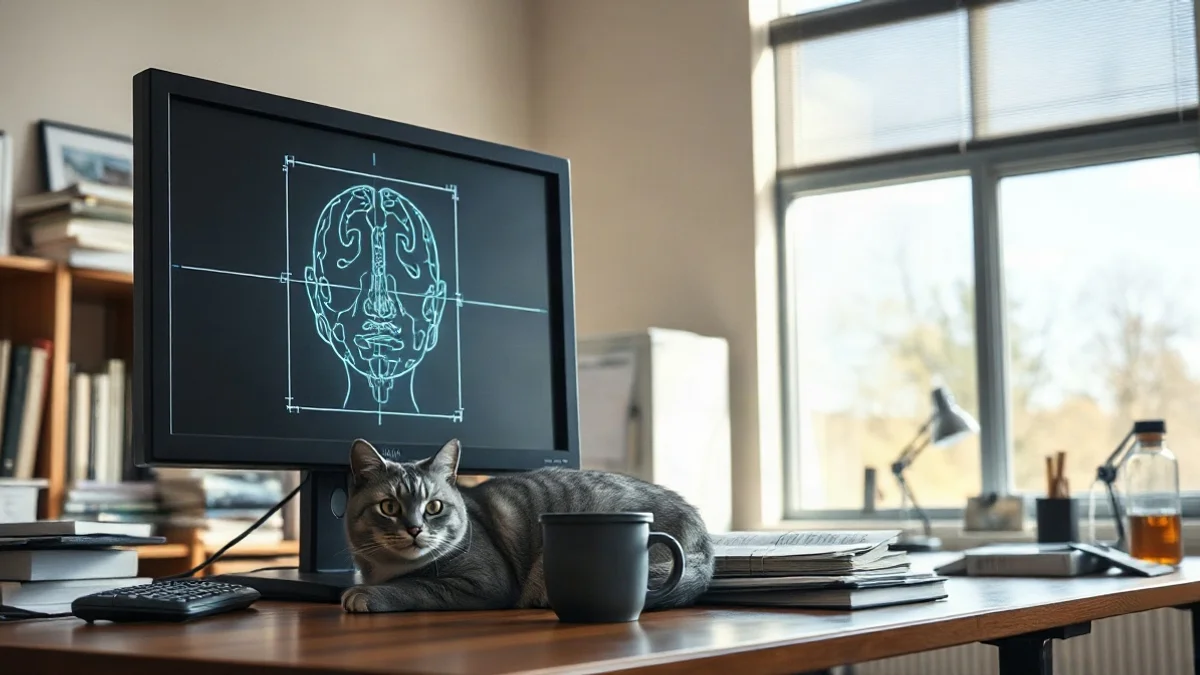
A 28-year-old man from the northeastern USA, identified as Karl, began experiencing a rare neurological phenomenon after undergoing brain surgery two years ago to treat an arteriovenous malformation—a tangled web of blood vessels prone to bleeding. Surgeons removed a portion of his right temporal lobe, an area involved in processing facial recognition. Following the procedure, Karl noticed that distinct visual features of his gray tabby cat, Luna, such as her stripes, dilated pupils, and eye sockets, would suddenly appear overlaid onto the faces of people he met in person or viewed on digital screens.
According to researchers from Dartmouth College in New Hampshire and Brigham and Women's Hospital in Boston, whose findings were published in the scientific journal Cortex, the condition also works in reverse. If Karl looks at a specific human face first, that person's eye shape and pupils can later appear on the face of another individual or even on Luna herself. Investigators noted that this bizarre perceptual crossover stems from a combination of two rare visual disorders working in tandem.
When Visual Memory Hijacks Facial Perception
The first condition is palinopsia, a phenomenon where a previous image or part of it persists or reappears in the visual field. In Karl's case, those lingering visual memories distort subsequent faces he encounters, manifesting as a form of prosopometamorphopsia, an impairment that causes distortions in the perception of facial features. Lead researcher Prof. Brad Duchaine, head of the Department of Psychological and Brain Sciences and director of the Social Perception Laboratory at Dartmouth, explained the mechanism.
"This case, where Karl sees features of his cat's face on human faces and vice versa, demonstrates how individual features can be retrieved from memory and influence our ongoing perception," Prof. Duchaine explained.
Karl's experience evoked memories of a 1986 scientific report published in the same journal, involving a woman who saw a poodle's face superimposed onto every passenger on a bus after observing a dog earlier. However, researchers noted that Karl's mechanism differs slightly, as only isolated features migrate across faces while the rest of the facial structure remains recognizable.
Generative AI Uncovers the Patient's Vision
To help the scientific community comprehend Karl's exact visual experience, Prof. Duchaine initially created a hand-drawn sketch before utilizing generative artificial intelligence to render a more realistic image. Karl provided direct feedback, allowing the pair to refine a series of visual representations that were published alongside the study.
Prof. Duchaine emphasized the clinical and psychological value of the technology, noting that artificial intelligence provides researchers with the ability to accurately illustrate distorted perceptions. He added that the tool helps patients communicate their unique experiences to medical professionals, friends, and family members alike. Prof. Duchaine's laboratory has already received inquiries from more than 250 individuals experiencing facial perception distortions, many of whom were previously misdiagnosed with psychiatric conditions or prescribed antipsychotic medications for what is fundamentally a neurological and perceptual phenomenon.