Voyager 1 and the Brutal Reality of Cosmic Distances
An in-depth look at Voyager 1's historic journey, exploring the brutal physics of cosmic distances, the limits of space travel, and why interstellar alien visits remain statistically improbable.
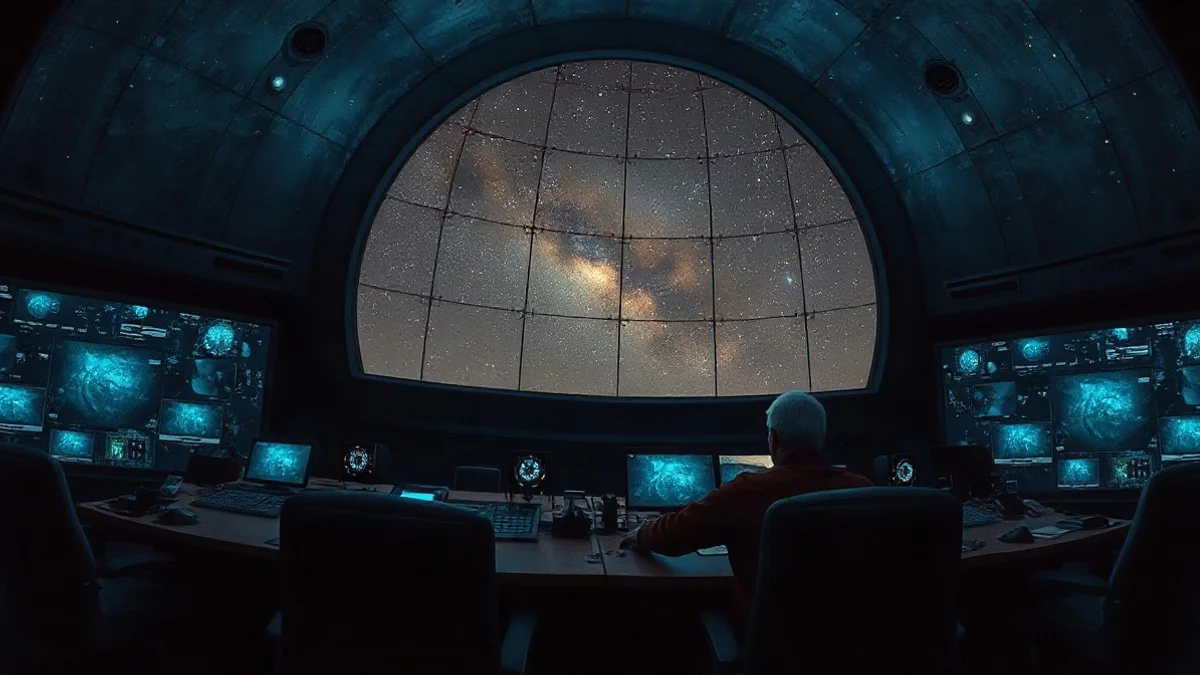
The universe is seemingly infinite, yet popular science fiction has conditioned us to view space as a bustling neighborhood. In franchises like Star Wars or Star Trek, starships engage warp drives, leaping across galaxies and star systems in mere seconds as if catching a commuter train. This cinematic narrative has embedded a dangerous optical illusion in human consciousness—the feeling that distant stars are just around the corner, separated only by a minor engineering hurdle from our first encounter with alien civilizations.
The Brutal Physics of the Cosmos
Yet physical reality is entirely different and profoundly unforgiving. The human brain is a product of biological evolution on the African savanna. For hundreds of thousands of years, our senses, intuition, and spatial awareness were shaped to estimate distances of a few meters for throwing a spear or a few kilometers for tracking a herd of gazelles.
Our minds are simply unequipped with cognitive tools to grasp numbers with twelve, fifteen, or twenty digits. We cannot truly comprehend what a light-year is, what interstellar vacuum entails, or how isolated Earth is within a cosmic wasteland of unimaginable boundaries.
61,000 Kilometers per Hour of Solitude
In September 1977, NASA launched the Voyager 1 probe from Cape Canaveral aboard a Titan 3E rocket. The original objective was relatively modest: to exploit a rare planetary alignment of the outer gas giants—occurring once every 176 years—to fly past Jupiter and Saturn, map their mysterious moons, and transmit the first close-up images of those frozen worlds.
Yet Voyager 1 pushed far beyond its original mission profile. Today, nearly five decades after launch, it holds the undisputed title of the most distant human-made object in history.
Cruise speed: approximately 61,000 kilometers per hour (about 17 kilometers per second). For comparison, an assault rifle bullet travels at roughly one kilometer per second; Voyager 1 is seventeen times faster.
Daily progress: roughly 1.6 million kilometers every 24 hours. Every single day, its distance from us increases by an amount equal to four times the distance between Earth and the Moon.
Total accumulated distance: between 24 and 26 billion kilometers from Earth (exceeding 160 astronomical units). A radio signal traveling at the speed of light now takes over 22 hours just to complete a one-way trip from Earth to the probe's antenna.
The Power of Gravitational Assist
How did NASA engineers propel a 720-kilogram metal craft to 61,000 km/h? No chemical fuel rocket ever built could carry enough propellant to accelerate a probe to such velocities in deep space. According to the Tsiolkovsky rocket equation, accelerating more mass requires exponentially more fuel, creating an engineering catch-22.
The brilliant solution was gravitational assist, often called the slingshot effect. This is an orbital maneuver where a spacecraft uses a planet's gravity and orbital velocity to alter its trajectory and increase its speed relative to the Sun, without burning a single drop of extra fuel. Imagine throwing a lightweight tennis ball toward a speeding freight train; the ball rebounds with added kinetic energy drawn from the train's momentum.
When Voyager 1 swept past Jupiter in 1979, it was caught in the giant planet's immense gravity well. Engineers deliberately directed it along a precise trajectory behind Jupiter's orbital path. The probe stole a minuscule fraction of the planet's angular momentum, slingshotting forward with phenomenal velocity.
The Illusion of Leaving the Solar System
In 2012, global media celebrated a historic milestone: Voyager 1 had supposedly left the solar system and entered interstellar space. Astronomically speaking, however, these headlines were entirely misleading. Voyager 1 did not leave the solar system; it merely crossed the heliopause.
The heliopause is the magnetic and thermal boundary where the solar wind—a continuous stream of charged particles streaming from the Sun—is halted by the counter-pressure of the interstellar medium. Crossing the heliopause means the probe exited the Sun's protective magnetic bubble, the heliosphere. However, the solar system is defined not by the solar wind, but by the Sun's gravitational field, which extends far beyond.
Far past Pluto, the Kuiper Belt, and the heliopause lies the Oort Cloud, a theoretical spherical shell of trillions of icy comets and primordial asteroids still bound by the Sun's gravity. Voyager 1 will need roughly 300 more years just to reach the inner edge of the Oort Cloud, and some 30,000 years to cross it entirely.
The Staggering Proximity of Proxima Centauri
Consider the closest star to our solar system: Proxima Centauri, a red dwarf located roughly 4.24 light-years away (about 40 trillion kilometers). While Voyager 1 is not heading in that direction, if it were aimed directly at our closest stellar neighbor, the journey would take between 75,000 and 80,000 years.
To put that into historical perspective, 75,000 years ago, early humans were just beginning to migrate out of Africa. Neanderthals still roamed Europe, agriculture had not been invented, and spoken language was in its infancy. All of recorded human civilization occurred within a minuscule fraction of that travel time.
Why Alien Visits Remain Unlikely
This immense scale brings us to the controversial topic of UFOs and UAPs. While many believe blurred radar footage or mysterious lights prove extraterrestrial visitation, astrophysicists point to the insurmountable barriers of distance and probability:
-
Rarity of Intelligent Life: Transitioning from microbial life to a technological civilization capable of building starships is exceedingly rare.
-
Vast Interstellar Distances: If technological life is scarce, the closest civilization likely resides hundreds or thousands of light-years away.
-
Relativistic Energy Limits: Einstein's theory of relativity forbids any mass from reaching the speed of light, making interstellar travel extremely energy-intensive and slow.
If an alien civilization travels at practical space exploration speeds—even ten times faster than Voyager 1—a trip from a star system just one thousand light-years away would take nearly two million years. The immense chasm between cosmic scales and lifespans renders rapid alien tourism highly improbable.
Conclusion: Our Pale Blue Oasis
The epic journey of Voyager 1 is not merely a masterclass in science and engineering; it is a sobering philosophical mirror. Built with 1970s technology and possessing less computing power than a modern digital watch, the tiny probe continues its silent voyage through freezing darkness.
It reminds us that the universe is not an accessible shopping mall or an instant adventure arena. It is a desolate, infinite ocean of time and distance, where star systems are isolated islands separated by decades of utter emptiness. Recognizing the gargantuan proportions of space should not breed despair, but rather sharpen our profound responsibility toward Earth—our fragile and irreplaceable pale blue dot.