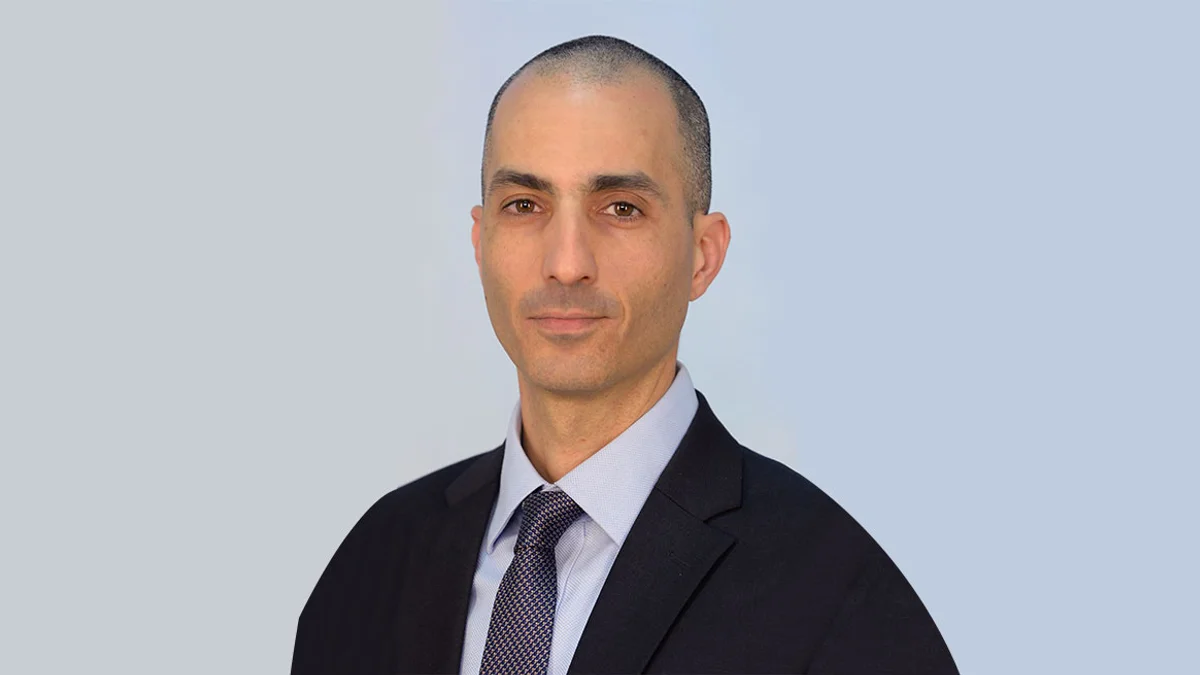
The futurist who predicts: "Many high-tech workers will realize they have no choice and will turn to blue-collar jobs"
A conversation with Dr. Roi Cesana, a futurist and AI researcher at Tel Aviv University. We discuss which sectors will be most affected by the AI revolution, the alternatives, and the real possibility that we will prefer robots to humans.

Part two of the series: Will we have work in the AI era?
Futurist Dr. Roi Cesana discusses a scenario where humanoid robots perform almost every task, including the work of psychologists. He warns of an unemployment wave that, if we fail to prepare for it, could leave a legacy of poverty affecting our children for 50 years. He predicts that many high-tech workers will eventually have to shift to blue-collar professions, adapting to roles as plumbers, glaziers, or taxi drivers.
Dr. Roi Cesana, your profession is futurology. How many times have you been told that "prophecy is given to fools"?
"Usually, I beat everyone to it and say it myself. People often ask if I have a crystal ball. I know all the jokes."
And your answer?
"I don't provide financial advice or tell people what to invest in. As the philosopher Michel Foucault said, I am here to help people understand that where there is a wall, one can open a window to a new idea. Humans tend to be shackled to the present. Often, you need a 'crazy futurist' to make them say, 'That's insane,' only for them to think minutes later: 'But actually, why not?'"
How many of your forecasts have come true?
"I am shocked that many things I wrote about have indeed come to pass. In my first book, 'The Guide to the Future' (2012), I wrote about an AI that would speak like a human, mimic writers, and step into the shoes of managers. I wrote it with a half-smile; the goal was never to be right, but to open up thinking."
Lemonade CEO Daniel Schreiber expressed concern about a massive wave of unemployment. What is your take?
"It is quite possible. We are talking about a wave: a rise in unemployment followed by a decline. I estimate the moderation will arrive after a few years. These are fateful years. If a crisis lasts five years, it leaves a deep mark that even the next generation will feel—much like the Great Depression in the US. We should arrive at this period as prepared as possible."
Robots instead of humans: Utopia or Dystopia?
Schreiber mentioned he stopped hiring juniors entirely. Where will the seniors of the future come from?
"That is a good question. It may be that in a decade or two, when AI does the bulk of the work, we will only need a handful of senior experts. It sounds dystopian, but it could also be a utopia: if medical services become ten times cheaper and the services themselves cost almost nothing, we will find a new balance. Already, 67% of teenagers use AI for their studies."
What do studies on the future labor market look like?
"They are confused. The EU report 'Preparing for 2040' details a spectrum of scenarios: from the conservative (AI is just hype and hallucinations) to the extreme, where in 2040 AI does everything. A study published in March 2026 examined a 2030 scenario where AI writes Pulitzer-level books, composes music, negotiates with Hollywood, and acts as a psychologist and fitness trainer. The chance of this scenario is estimated at 14%."
What about 'Human Washing'—using a human face for services actually performed by a machine?
"Exactly. 90% of the time we will talk to computerized psychologists, but when we want to show we are serious or need human warmth, we will turn to a person. Professions requiring 'human touch' will remain the most essential."
Will high-tech workers have to move to blue-collar jobs?
"There is a real chance. Many people fired today will find new jobs, but many will realize they have no choice. There is a stigma that being a taxi driver is less honorable than being an analyst. I fear a repeat of the US 'Rust Belt' scenario of the 70s, where laid-off workers refused to retrain because they viewed new roles as 'not for them.' The government must help people not only with skills but with the psychological transition—from one identity to another."
And what about managers?
"In the foreseeable future, middle managers are at risk. Organizations are becoming autonomous, and the need for those who simply supervise teams is disappearing. Managers will be required to execute projects themselves. The position of top-level managers (C-level) remains safe for now."