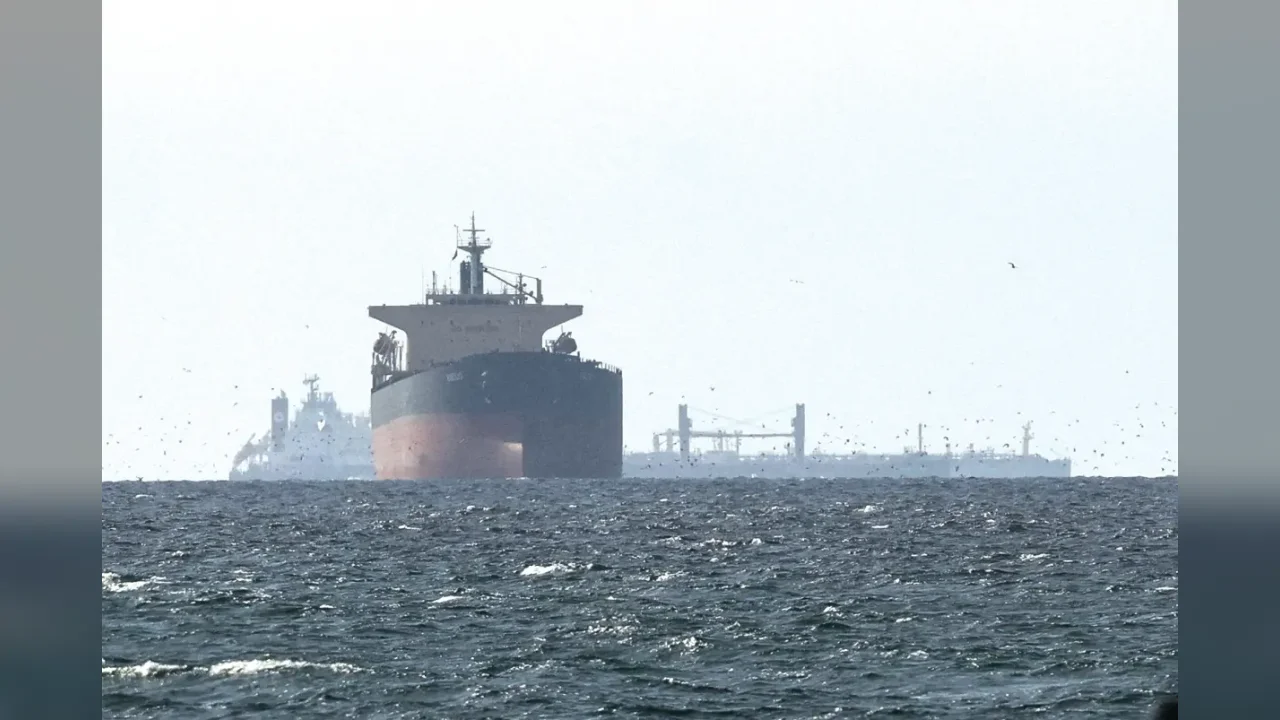
The F35 that vanished into thin air: How do you find a stealth jet that goes missing?
On September 17, 2023, the US Department of Defense requested public assistance in locating an F35 fighter jet that went missing after its pilot ejected. The stealth aircraft continued flying for some time, posing a significant challenge for search and rescue operations.
Hello, this is the Captain. On September 17, 2023, a very strange news item appeared in US news broadcasts: the US Department of Defense requested the public's help in searching for an F35 stealth fighter jet that had simply gone missing. It is 4.4 meters tall, grey in color, and answers to the name 'Lightning'. The internet was filled with memes and jokes — and rightly so, as Americans were stunned: how did the Pentagon manage to lose a hundred-million-dollar aircraft? There are 200 countries in the world, and only twenty of them are wealthier than the US Department of Defense — and you need our help?
But this is no joke. Our story begins the day before, when a US Marine Corps F35B — the model capable of vertical takeoff and landing — went on a training flight from a base in Beaufort, South Carolina. About an hour later, it passed the city of Charleston and experienced a mysterious system failure. The pilot lost control, was forced to eject, and the aircraft, cheekily, continued to fly and disappeared. The pilot parachuted down, landed in the garden of a surprised family, called emergency services, and reported: 'Send rescue, I have no idea where my plane is. It was heading north, and that is all I can say.'
An emergency protocol was immediately declared: such an F35 carries a great deal of secret and sensitive technology, and there is no shortage of foreign spies in the US. But no one in the military had any idea where the stealth jet was. North of the ejection point are thousands of square kilometers of forested hills and lakes. A plane fell in the forest, and no one heard.
How does a fighter jet go missing?
Easily. The sky is big, the planes are small, and one that falls into a lake or sea won't even start a fire. In principle, before ejection, one is supposed to direct the craft to an unpopulated area and, afterwards, report where it fell. But in this case, the F35B was not under the pilot's control; it pitched its nose above the horizon and flew away. Planes that continue to fly after ejection are not a new phenomenon; it is something that has happened in history and will surely happen again in the future: these are machines born to stay in the sky, and as long as there is air moving under the wings and enough fuel, the plane will continue bravely even when its master is dangling toward the ground in a parachute.
To understand how the world's armies search for fighter jets, we will look at the detection methods. The challenge is very great: stealth from radar is not something that can be turned on and off. It is not achieved through a device, but thanks to the materials the plane is made of and its shape. Technically, if you open the weapons bay doors or lower the landing gear, a surface is created that produces more radar returns, but it is still very difficult to track.
Why was the search so difficult?
First of all, you look at the map and the flight plan. Military aircraft fly according to defined coordinates. Here, that did not hold: the malfunction occurred at a low altitude of 1,700 feet, but the stealth jet did not fly according to the flight plan and proceeded chaotically. It did not lower its nose, but rather climbed, which made it very difficult to analyze the areas where it could have fallen.
Another method is the use of automatic communication (IFF). An aircraft that does not return a signal might be considered an enemy aircraft. The Pentagon stated that the transponder was working when the stealth jet took off, but the malfunction that occurred somehow turned off the transmitter. Additionally, the F35 has a dedicated device to produce radar returns while flying in crowded skies to avoid collisions. However, precisely in the training in question, the artificial return equipment was not installed.
Analysis of radar history also did not provide enough information, as antennas need to be prepared for such a situation, and the Americans did not know that a plane was about to go AWOL. In the end, a search helicopter crew spotted glints among the trees only two days later, about 128 km north of the ejection point. It did not start a fire and was located literally by luck. Have a pleasant flight!