Alone in the campaign: The fate of old buildings after TAMA 38
Following the cancellation of TAMA 38 and the industry's shift toward large-scale 'Pinui-Binui' complexes, many old residential buildings are being left behind. Experts discuss whether alternative mechanisms, such as the 'Shaked alternative,' can provide the necessary strengthening and protection for individual buildings, or if they risk being excluded from urban renewal.
Will old residential buildings that are not part of a large 'Pinui-Binui' (evacuation and construction) complex struggle to advance strengthening and protection processes? New data indicates that 'building renewal,' which is intended to provide a solution for these structures, is not taking off, and the volume of building permits granted in this field is in a nosedive. This is bad news for apartment owners in those old buildings, but also for local authorities, who have yet to find a solution to the problem.
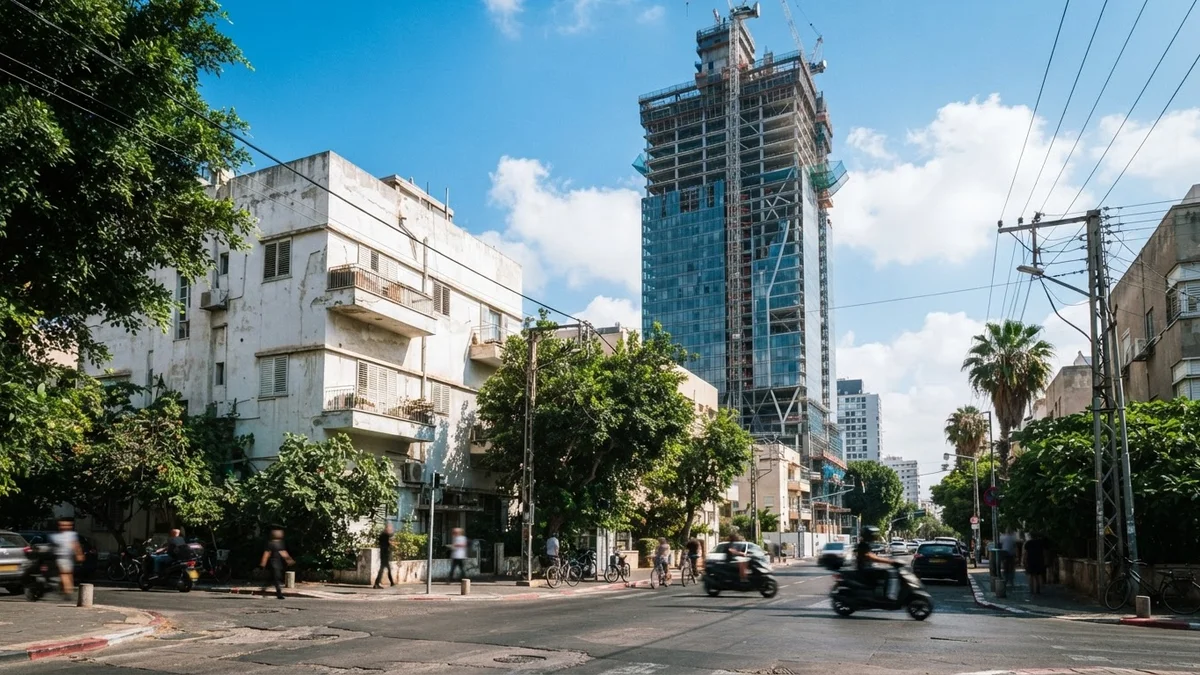
'The cancellation of TAMA 38 and the massive shift to 'Pinui-Binui' complexes have left neighborhoods, and sometimes entire cities that are not suitable for complex renewal, with tens of thousands of old and dangerous buildings without a practical solution,' explains Tomer Tzaliah, Vice President of the Association of Contractors and Builders and Chairman of the Entrepreneurship and Construction Division. According to him, the data illustrates a significant delay by local authorities in promoting and approving comprehensive plans. The situation is especially severe in the periphery, where the absence of suitable plans is prominent, leaving entire cities without a horizon for renewing individual buildings.
Eli Gabay, one of the owners of the Gabay Group, addresses the issue: 'The reality on the ground is more complex, because not every building can fit into a large complex. Therefore, a diverse basket of solutions is required, not one uniform solution for the entire country. Individual buildings in city centers, in high-demand areas, can in many cases economically justify renewal even without an entire complex, while in areas where land values are lower, additional incentives are required to make the projects worthwhile.'
Creative planning solutions
Eliav Maimon, partner and CEO of Ramot Ba'ir, believes that this is a 'planning challenge that can and should be solved.' According to him, 'For buildings that have already remained alone, creative planning solutions can be adapted, for example, to make a TABA (city zoning plan) for them in two blue lines, which will allow them to be attached to another complex, even if they are not in geographical continuity.'
Itamar Ben Shalom, owner and co-CEO of Ben Shalom Entrepreneurship and Construction, proposes a two-track solution: on one hand, to continue to strengthen the complex 'Pinui-Binui' model, and on the other hand, to develop a dedicated, more applicable, and certain track for individual buildings. Without such an answer, a significant part of the veteran structures in old cities will remain behind, both in terms of quality of life and in terms of safety.
Adv. Ido Shmueli emphasizes that the solution lies with local authorities: 'It is forbidden to leave tenants without urban renewal, because our defensive resilience is measured by these buildings having MAMADs (protected spaces). The economic model must include the addition of housing units for the entrepreneur so that they can carry out the project.'