Football legends, jerseys, the cup - and the memories that became a journey through time
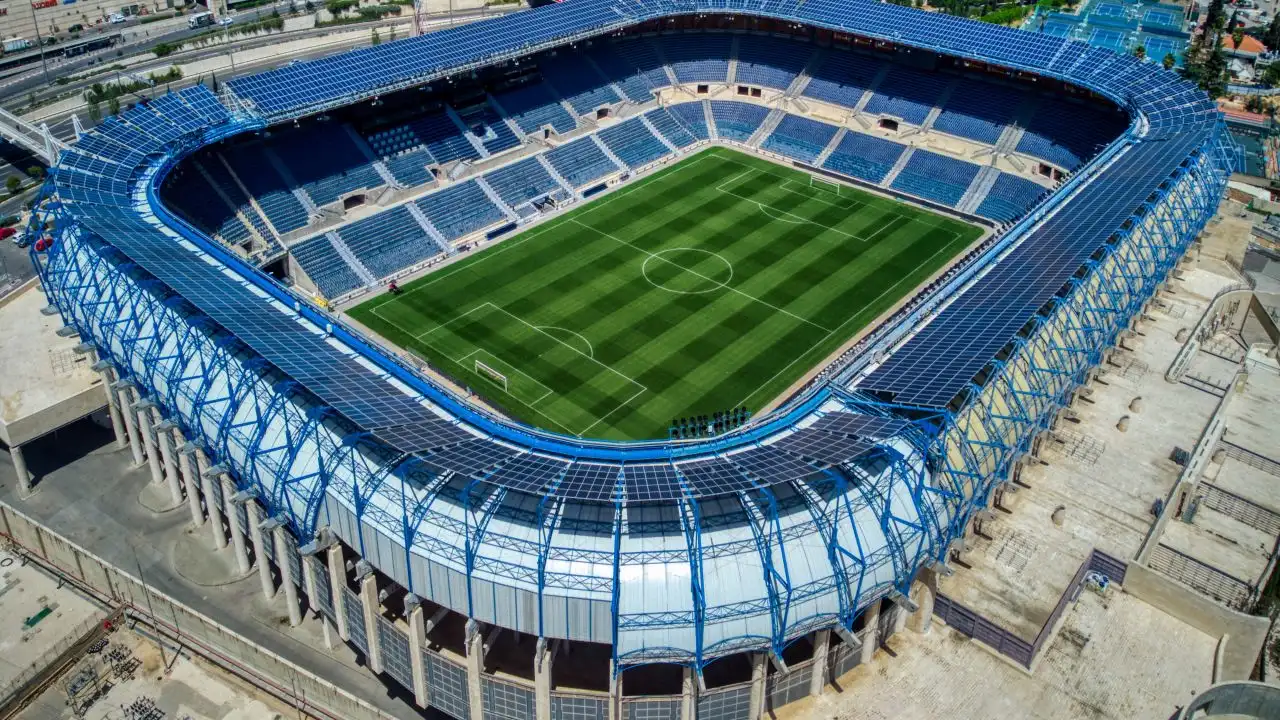
On Saturday, a new season will begin, and new players will become heroes. But before the first whistle, we stopped to remember those who were here before them. Spiegler, Ohana, Sinai, Nimni, Visoker, and other legendary players met at Bloomfield for one photo that turned into a nostalgic journey in a single frame.
There are photos taken for the newspaper, and there are photos that, even while being taken, already belong to history. In the 80s and 90s, the opening round of the season was a holiday for me. In a world without the internet and without push notifications every three minutes, this supplement was the bible. And the festive posters were the first meeting with the teams, the new uniforms, and especially with the players who were missing from the exact training session where the photo was taken. There was always some official who pushed into the frame and hid a youth player, and always someone who for some reason came in a different shirt.
On Saturday, a new season will begin. New players will become heroes, children will fall in love with football, and new memories will be born. But before the first whistle, I wanted to stop for a moment and remember those who were here before them. We thought we were coming to shoot a poster for the opening of the season, but we left with a yearbook photo of our childhood.
"If it's important to you, I'll come"
The key to the photo was Motaleh Spiegler. I called, and the answer was short: "If it's important to you, I'll come." With Eli Ohana, it was a bit more complicated. I love Ohana. He was the biggest pop star of Israeli football. I think at the beginning of his career, there were more posters of him in "Ma'ariv LaNoar" than of George Michael. I sent him a WhatsApp. "Eli, are you willing to come?", and he replied: "If it fits my schedule, I'll come with pleasure."
Only then did I discover that Ohana lives on Jerusalem time. Through Instagram, I understood that he was on a family vacation. And I had no idea if Eli Ohana was coming. The salvation came precisely from the spokesperson of Hapoel Jerusalem, "Talk to Michel Dayan. If Michel tells him - he will come." Thursday, 17:15. A car stops near Bloomfield. Michel Dayan gets out and shouts at me: "Look who I brought you."
Ohana in person. "Tell me, didn't you intend to answer me?", Ohana smiled. "When I'm on vacation with the family, there is nothing more important to me than the family. I turn off the phone, close everything. But here, I came." "Eli, I'm a Hapoel Tel Aviv fan. Is it logical that I'm standing next to you and my knees are weak?", "That's already your problem. I'm just Eli. You, the fans, make us great." A small lesson in humility from the school of Eli Ohana, the unavailable.
The gate to love
When I arrived at Bloomfield, Itzik Visoker was already there. For me, he was my gate to the world of football. When I was six, he had a small and crazy shop in Ramat Gan called "Sport Visoker," and there I received my first goalkeeper gloves. And so, more or less, I became a goalkeeper. Because when you are six and the goalkeeper of the Israel national team gives you your first goalkeeper gloves, there aren't really many other options. We are all children again.
For the photo, I asked two of my good friends, Mariano Idelman and Omer Etzion, to come. And when I saw them excited on the grass, I understood that this is perhaps the essence of being a football fan. We grow up. We have children. Some of us even become people that others recognize on the street or see on TV. But when we meet the players we grew up on, something happens. We return to being children. And they return to being idols. Everyone is a bit embarrassed. And everyone loves football.
Assembling history
Slowly, Bloomfield filled up. Oz Moalem, the photographer for "Yedioth Ahronoth" and Ynet, and a dear friend, started to arrange the frame. I pass between them like a barber before a wedding. Arranging a shirt, straightening a wrinkle, checking hair. "Remind me, what time did they use to take these posters?". Stav Elimelech answered immediately: "Always at noon. And they always put us against the sun. Look at the pictures - in all of them, we have our eyes closed." So this time we scheduled for five. It took Israeli football forty years to learn to move the shooting away from the sun.
Within this whole operation, I discovered something beautiful about Israeli football today. To bring the players and especially to get the shirts, I spoke with almost all the team spokespeople. I discovered a group of young, nice people, and above all, football kids. Once it seemed that former players were sometimes a burden that the club had to carry. The generation that is around the teams today grew up on these people. For them, they are not a nuisance from the past but the face of the club. They want to honor them, keep the memory, connect them back to the clubs where they became legends. Well, almost everywhere. Maccabi Petah Tikva, for example, has no fan shirts. And Zeevik Zelzer needed a shirt. So at 21:30, I met their spokesperson and got a real game shirt, the kind that two days later was still supposed to go on the grass in the Toto Cup. So Maccabi Petah Tikva, a small tip for the opening of the season: make shirts for the fans, who knows, maybe in 40 years Liran Hazan's shirt will be historic.
The man who ended my childhood
Only Avi Nimni is missing. And then I remember that his shirt is waiting in the Maccabi Tel Aviv store at Bloomfield. I, the red one, enter the Maccabi store. A yellow bag was waiting for me with the name "Yaron Shilon" on it. This sentence too I didn't think I would ever write. When he finally arrives, I call my son Yarden. "Meet, this is Avi Nimni. The man who ended my childhood. All the nineties he would come to the derby and kill me." Nimni started talking to Yarden at eye level and then says to him with a half-wink: "Don't worry. Hapoel has a very strong team this year. You will be happy."
On one of the benches were the famous checkered shirt of Hapoel Be'er Sheva - and the classic shirt of Eli Ohana. Arnon Shasal was hanging around nearby. Many of the old Israeli football shirts did not survive. Arnon found a way to preserve them: he locates plain shirts in Europe and restores the original emblems and sponsors on them. Not to sell. Just because he loves it. The shirts he restored suddenly returned to the bodies of the people who turned them into mythology. And if a piece of old cloth can make an adult person get excited like this, who am I to argue.
The Holy Grail
The picture is almost ready, but something is missing for me. So I brought a cup from home. It's a bit shaky, a bit shabby. "What is this cup?", they asked there. "This is the cup that Moshe Sinai lifted in 1983." Suddenly everyone looked. After winning the cup, the people of Hapoel dedicated the cup to Avraham "Yashin" Bueno, the beloved mascot and kit man of the team. Years later, Yashin passed away from cancer and his brother Eli continued after him in the club. About a year ago, Eli dismantled his mother's house after she passed away and called me. "Yaron, come take." I asked: "What to take?". He replied: "Come. See. Take." And that's how the cup reached me. It's not in the Association. It's not in the museum. It's not even at Hapoel Tel Aviv. It's with me. The players looked at me as if I were a crazy man. Which is true. But now, after more than forty years, this cup is again on the grass at Bloomfield. And in a moment, Moshe Sinai will lift it over his head. Like then.
Size doesn't always matter
Shalom Akiva, the representative of Tiberias, sat a bit embarrassed. Around him Spiegler, Ohana, Sinai, Nimni, Banado. People with championships, cups, Israel national team, Europe, and the World Cup. And Shalom looked as if he was still trying to understand why the hell we invited him to this party. "Shalom, you are here because you are one of the faces of Ironi Tiberias. When we tell the story of the teams that are in the Premier League today, you are part of this story." In the picture, he sat down next to Eli Ohana. You can almost hear his heartbeat through the photo. And it reminded me that size doesn't always matter. Not every club has a Motaleh Spiegler. But every team has someone who for one child, one stand, or one city was the man they looked at. And that is the whole essence of this picture.
And in the case of Tiberias, there is perhaps something more to it. This is a city that hasn't always had it easy in recent years, and its name appears in the headlines more than once for reasons that have nothing to do with football. So maybe it's nice, at least for one moment, to let it be just Tiberias again. A city with a football team. And with someone it can call a star. 7 red heart.
7 red heart
Moshe Sinai is my football father. My personal idol. And through him, to a large extent, I pass on to Yarden my love for football and Hapoel Tel Aviv. Moshe Sinai, it turns out, doesn't even have one red shirt in the closet. He gave them all away over the years. So before the photo, I asked the management of Hapoel Tel Aviv for a new red shirt, number 7, and on the back the name Sinai. When he arrived, I gave Yarden a red bag. "Go give it to Moshe," and I watched my child walk to my idol. There are moments when you don't need to explain to your child why they are important. It's enough that he is there.
Later, I pulled out an old Ata shirt that we restored for "Game of the Sabbath." Sinai is not exactly a person who spreads emotions everywhere, but this shirt took him back. To the beginning of the eighties. To the child who then became Moshe Sinai. He wore it. And then I looked at Yarden. In the last year and a half, he said goodbye to his two red grandfathers. First to Grandpa Yigal, and a short time ago to Grandpa Arnon, who loved Hapoel Tel Aviv perhaps even more than me. A ten-year-old child doesn't always know how to give names to all these connections. To father, to grandfather, to memory, to football. He only knows that he loves. And now he is standing on the grass at Bloomfield, in a Hapoel shirt, and sees Moshe Sinai lifting again a cup that his father still remembers and keeps from childhood. And suddenly I understood that this is perhaps the most beautiful gift I can give him. Something that will connect him to his two grandfathers. Something that will connect him to me. And maybe one day, when he is a father, also to someone who hasn't even been born yet. Because in the end, this is probably the way fandom is passed on in the family. You don't explain it. You pass it on.
In the end, the picture was taken. People who once went up to the field to beat each other were now standing shoulder to shoulder. And I looked at them and thought how much of our childhood is inside this picture.
"That's it, can I go?"
Towards the end of the shooting, Motaleh approached me. "Yaron, that's it? Can I go?". Inside me, I knew not. I hadn't really talked to him yet. I took him to a bench at Bloomfield. On one side Mariano, on the other side Omer, and I opposite him. Mariano and Omer barely spoke. They just drank every sentence with a straw of love. He told about his debut game in the seniors of Maccabi Netanya. 16 years minus two weeks. Fourth minute, a ball reaches him - and a goal. "The ball hit my head and went in," he said. "And at that moment I understood that I don't know how to head." Almost 66 years have passed and he still remembers his first goal not as the moment he discovered how great he is, but as the moment he discovered what he doesn't know how to do. That's Motaleh. There is a slightly deceptive humility in him. He knows exactly what he did and how great he was. But every time the story gets close to becoming mythology, he finds a small way to puncture it. Once he scored directly from a corner. The next day they told him he was a genius. "I'm not a genius. There was wind."
And then I asked him the obvious question in an event that is all about looking back: what is the greatest moment in your career? Motaleh looked at me and replied: "Hasn't arrived yet." For a moment I thought he was laughing. "I'm only turning 82 next week. Why should I talk about the greatest moment? Can you summarize a whole life in one minute?". And there, on the bench at Bloomfield, I understood something. He wasn't busy with what was. From his point of view, the great moment is still waiting for him. Before we got up, he said one more sentence that stayed with me. "People loved what I did, not me," and then stopped, with his little smile, and added: "But I did it so well that they are right."
Motaleh got up from the bench. Almost 82 years old and the youngest of us all. A Bar Mitzvah boy. Towards the end of the meeting, when the players started to say goodbye and leave Bloomfield, I asked Oz Moalem for one more picture. I placed the cup on the grass and lay down next to it. "Shoot, shoot," I asked. Oz shot, lowered the camera, looked at me and said: "You are actually a Bar Mitzvah boy who hasn't grown up yet." I was silent. He was right. Which means the camera sees everything.