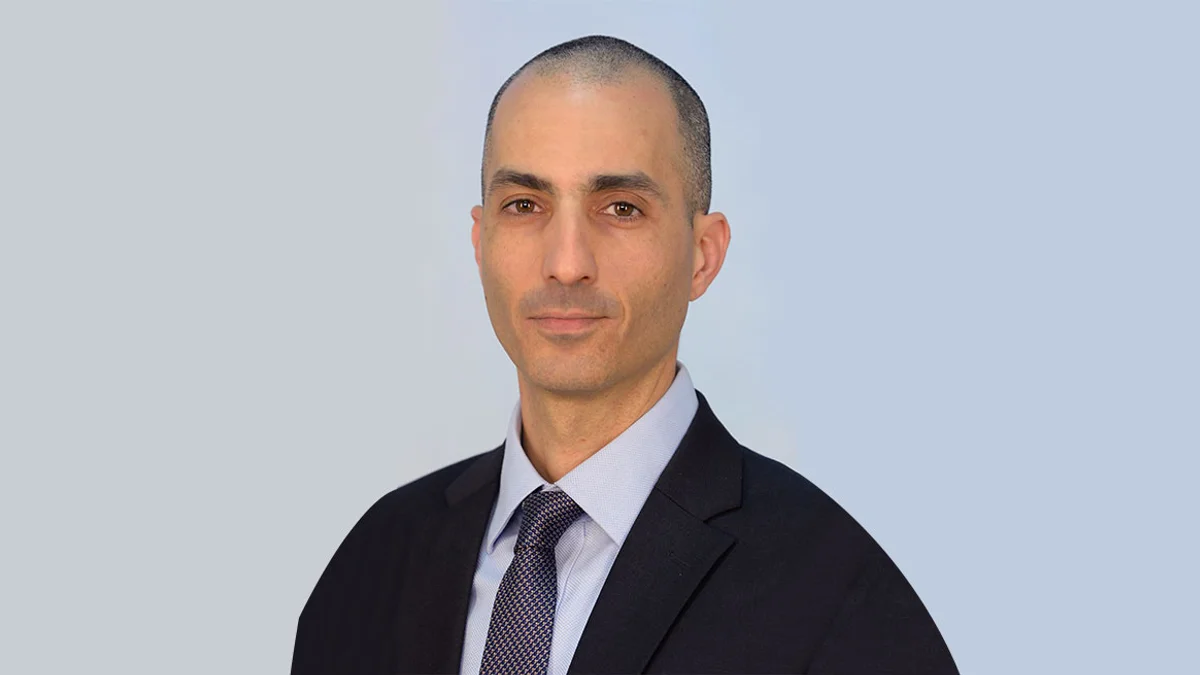
The senior Treasury official who responds to claims of a teacher shortage and argues: "We must cancel school on Fridays"
Ohad Elkabets, in charge of teaching staff at the Treasury's Wage Department, will lead the negotiations on the wage agreement with the teachers' unions. In an interview with Globes, he explains why canceling school on Fridays is necessary to reduce the burden on teachers, warns against a wage spiral in the economy, and expresses reservations about transferring employment to local authorities. He also shares how much he pays for kindergarten.
Just before the opening of negotiations for the next teachers' wage agreement, Ohad Elkabets, in charge of teaching staff at the Treasury's Wage Department, gives an interview to Globes and lays out his plans for tackling the shortage of teaching staff. He identifies the cancellation of school on Fridays as a game-changing step, expresses reservations about the Budget Department's plan to transfer the employment of teachers to local authorities, talks about the behind-the-scenes with Yaffa Ben David and Ran Erez, and also shares his personal account and the payment for his children's kindergartens.
Performance in constant decline
"The education system in Israel is serious, strong, and good in many respects, but it faces significant challenges. The birth rate here is high relative to the Western world, and therefore the education system is growing at a very high rate," declares Ohad Elkabets at the beginning of the interview. Beyond the educational framework itself, he mentions that "the education system in Israel allows the economy to work and is the cornerstone of building the adults who later contribute to its development."
When examining student achievements in international comparison, it seems that the first hat is fully realized and the education system is perceived by many as a babysitter. But in the second hat, the state of human capital is not good.
"This is true in terms of the performance of the education system. Despite increasing investment, performance is declining. This is the highest civilian budget in the state budget, and the investment per student is high even by international standards and higher than the OECD average. The teacher staff is improving — we are reaching an average of one teacher for every 11.4 students — a figure influenced by special education, but it concerns the education system as a whole. If Israel were one big school, there would be no shortage of teachers. Alongside this, it should be remembered that in recent years, Israeli students have experienced COVID, alongside wars — and the efficiency of learning from home is controversial."
Elkabets clarifies that the Ministry of Finance identifies that "what was invested in recent years did not work," and emphasizes that against the backdrop of rising security expenditures, "the need for change is becoming sharp and acute" to ensure returns on investment. "The data shows that if you don't choose where to invest or how to invest, you lose," he says, borrowing terms from the capital market, where the method of routing is no less important than the amount. Elkabets believes that in the education system, it is necessary to identify the structural problems that require root treatment and re-plan the allocations. "The data shows that the allocation is inefficient. In the test of results, we invested a lot and the performance did not respond accordingly," he concludes.
Ohad Elkabets, Deputy Commissioner for Wages at the Ministry of Finance
-
Personal: 39 years old, married +2, lives in Rishon LeZion
-
Professional: In charge of teaching staff and local government in the Wage and Labor Agreements Department at the Ministry of Finance. Formerly an economist in the Budget Department of the Ministry of Defense, in the Prime Minister's Office, and in the macro team of the Wage Department at the Treasury
-
Something else: He regularly starts his day by swimming in a pool
And yet, many claims are heard about a shortage of teachers and the quality of teaching.
"The shortage is a qualitative shortage," replies Elkabets. He explains that it is difficult to recruit science teachers, alongside a manpower shortage in the central region. He attributes the main reason for the decline in quality to the increase in study hours. "We tried to solve every problem by adding hours. To meet demand, the principal must lower quality, and we see phenomena of teachers who have not yet completed a teaching certificate or a degree in full. We have quality teachers who hold the system on their backs, but the fact that they teach many more hours here than in the rest of the world has created such a heavy burden that it is impossible."
Too good relationships?
It can be argued that in a situation of a shortage of quality manpower, wages should be raised, but Elkabets warns against this. According to him, in a labor market where teachers earn well even by international standards, a sweeping wage increase will create a shortage in other sectors. "We influence 800,000 workers in the economy and I can create a wage spiral with my own hands," he explains.
According to him, improving the quality of teaching requires structural changes, threshold requirements, and training, not across-the-board wage increases. "In high-tech, when I want an excellent programmer, I will pay him more, but in large masses, it doesn't work like that," he emphasizes. As an alternative, he points to the Ministry of Finance's recent move to recruit teachers on personal contracts, which is intended "to improve quality with a focused response to focused needs."
They have been talking about this for years, how many teachers on personal contracts are there today?
"Very few, this is just the beginning. The agreement with Yaffa Ben David for personal contracts was signed in 2022, but the implementation is getting underway this year. They will be employed for ten months, will earn 19.5 thousand shekels for a position of 30 weekly teaching hours, and at the end, they will receive a grant of 20 thousand shekels. The advantage is the flexibility that will allow designing the position, unlike other teachers — he will be able to direct them to a specific group or to lead a project."
At the end of the year, the current agreement will come to an end, and Elkabets will lead the negotiations on the new agreement with the Teachers' Union, which is expected to include significant changes. Elkabets says that "the relationship is good and there is a fruitful dialogue. We show them transparently how we see the system, and they are full partners in the change."
Perhaps this good relationship prevents painful steps for teachers? The Minister of Finance claimed that deep change in the education system requires a minister who is willing to stand up to a year-long strike.
"The scope of changes required requires brave Ministers of Finance and Education, but the teachers' unions are partners who are here to stay. We reflect the problems to them in the hope that they will understand their national role. If we encounter a complete lack of understanding regarding the need to move forward, of course, we will do what we can for the benefit of the citizens."
And yet, one of the criticisms in the government is that your department prefers industrial peace over substantive changes. Where is the line drawn?
"This department has led huge reforms in the ports, in the Electric Corporation, and completely changed the public sector with the framework agreement," he reminds. "In contrast, when we did not reach agreements, we went with Ran Erez to a strike until he broke it. We are businesslike and examine every deal, but we are also more sophisticated than saying all the time 'let's go on strike,' because that is not a work plan."
Kindergarten for 8,000 shekels
Elkabets mentions the achievements that have already passed in previous agreements, including the treatment of starting teachers' wages, reforms like "New Horizon," the implementation of personal contracts, and providing reward flexibility to principals. However, he declares that the upcoming agreement will be much more significant and will include deep structural changes, primarily the move to cancel school on Fridays.
"We teach a lot of hours, which creates high demand for teachers but no benefit in performance," explains Elkabets. According to him, teachers are collapsing under the burden and are forced to perform many substitutions due to the demand for extra hours, all this in parallel with ongoing coping with parents, students, and national crises. The goal of the move, he concludes — "to reduce the burden on teaching staff, give them leisure, and create higher quality education."
"Our idea in moving to five days of study is to reduce hours without shortening Sunday through Thursday," explains Elkabets. The current situation, where the system operates six days and teachers work five, leads to 15% of the staff being absent every day. "Think about a principal whose staff is not permanent. We know what happens when the educator is not at school," he adds. At the same time, the move will reduce the huge gap in vacations compared to parents, which "costs the economy a lot," by shifting Fridays to summer days and a defined reduction in study hours.
According to him, the goal of the move is to balance the gap between the teacher's busy work week and the relatively free school year. Alongside it, he marks two more central goals. One is increasing pedagogical flexibility and adapting it to the technological reality. "Attention today is limited and maybe we need to build lessons of half an hour and not 45 minutes," he suggests. The other central goal is dealing with the centralization of the Ministry of Education, which he claims is simply inefficient.
In the Budget Department, they are trying to promote a move to transfer the employment of teachers from the Ministry of Education to local authorities. Do you agree with them?
"First and foremost, we need to deal with the decentralization of powers. This is a complex system and only then can we deal with the question of the employer. We cannot ignore the fact that we have the Tel Aviv Municipality on one side, Nazareth with an appointed committee on the other, and Kiryat Gat where I grew up. How do you create a system that will work well in all of them? The goal is quality education throughout the country."
As a father of children in early childhood, how much do you pay for educational services?
"More than 8,000 shekels per month. It is very expensive. We must understand how critical the investment in early childhood is and find the way to invest more there, because the return on investment at these ages is significantly higher."