Urban Renewal: The Developer's Hidden Partner
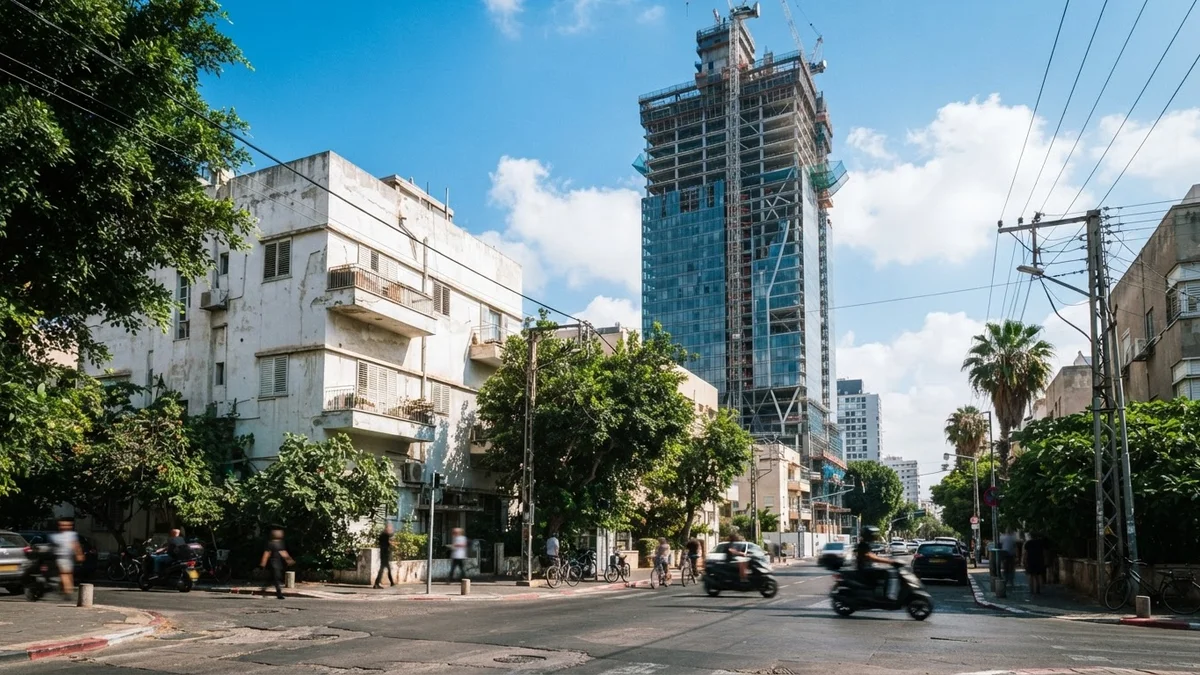
In recent years, local authorities have become dominant partners in urban renewal projects, not only as regulators but also as stakeholders requiring public spaces within residential developments. While this addresses the need for public infrastructure, developers warn that excessive or unclear demands can harm economic feasibility, create uncertainty, and delay project implementation.
"Local authorities have a central role in the success of urban renewal projects, and the need for quality public spaces is an integral part of proper urban planning," explains Ronit Ashed-Levi, CEO of Africa Israel. Her words come against the backdrop of the question regarding the local authority's share in urban renewal processes. According to her, "The combination of public buildings, education, community, and open spaces allows for absorbing population growth and improving the quality of life in the entire neighborhood. Alongside this, it is important to maintain a balance that will allow projects to remain economically and planning-wise feasible. When the local authority, the developer, and the residents act from a shared vision of the city's needs, it is possible to promote quality projects that create real value for both the tenants and the entire urban space."
Nechama Bugin, Chair of the Real Estate Appraisers Chamber, notes that although the importance the local authority attaches to the process is clear, local authorities are indeed demanding more and more space within the framework of urban renewal projects: "In recent years, we have witnessed a growing trend of local authorities seeking to receive public spaces as part of promoting urban renewal projects, recognizing the needs that population growth creates. The market has mostly adapted to this mechanism, and it does not constitute a significant barrier as long as the requirements are in reasonable proportion to the project's scope and its economic capacity. The problem arises when the requirements exceed the limits of reasonableness, when they are disproportionate, when they are not based on a clear planning need, or when they are raised at a late stage and harm the certainty required for promoting the project."
Amir Heller, Deputy CEO of the Almog Group, addresses the municipality's need and the reality on the ground: "There is no doubt that urban renewal also requires mixed uses and providing answers for public buildings in residential buildings. The purpose is definitely worthy and even necessary. Where possible, the Almog Group even tries to allocate a 'brown area' separate from the residential buildings to create an independent public building. In dense plots, we integrate the public building into the residential building and provide it with a separate entrance to create a separation that is convenient for everyone. Alongside the advantages, one must understand that the process of signing an agreement for the construction of public buildings with the municipality is not simple and takes time. In addition, the offset from the betterment levy is only partial and imposes a heavy burden on developers."
The complexity increases significantly
Roi Gilad Doron, CEO of Dan Nadlan, agrees that integrating public spaces is an important goal, but adds that it makes projects more complex: "The cooperation between real estate developers and municipalities in 'pinui-binui' projects has a clear advantage in that it provides a solution to the shortage of public spaces and creates higher-quality urbanism. However, alongside the advantages, the complexity increases significantly. Every square meter transferred to the public harms economic feasibility, negotiations are prolonged, and the lack of uniformity between authorities creates uncertainty for developers. Furthermore, there is a built-in conflict of interest, as the municipality effectively acts simultaneously as both a regulator and a beneficiary of the project."
Tomer Reifman, CEO and owner of Yaaz Yazmut, believes that integrating public spaces is important but must be reflected in the economic calculation: "As a developer, I understand the municipality's request to participate in public benefits. Authorities often tend to ask developers to build a kindergarten, community center, or parking lot dedicated to public needs. Projects should be examined according to 'Standard 21' and meet the profitability threshold required by the standard. The local authority should take this into account, for example in the form of a reduction in the percentage of affordable housing in the project, a reduction in the betterment levy, or the addition of building rights."
Yonatan Azar, VP of Urban Renewal at the Y.D. Barazani Group, summarizes: "If in the past the municipality was in the status of a regulator, today in more and more urban renewal projects it effectively becomes a partner in the venture through the allocation of public spaces. This is a fundamental change that directly affects the project's economics and timelines. The main challenge today is to find the balance point. In places where the balance is maintained, renewal becomes an engine for urban growth. In places where each side in the process pulls in a different direction, planning and economic cumbersomeness is created, which delays the plan's promotion and makes it difficult to execute the project."