Gorillas Outsmart Electric Barrier with Living Ladder in Rare Discovery
Researchers at Tel Aviv University documented western lowland gorillas at the Ramat Gan Safari forming a living ladder to bypass an electric barrier and reach high foliage.
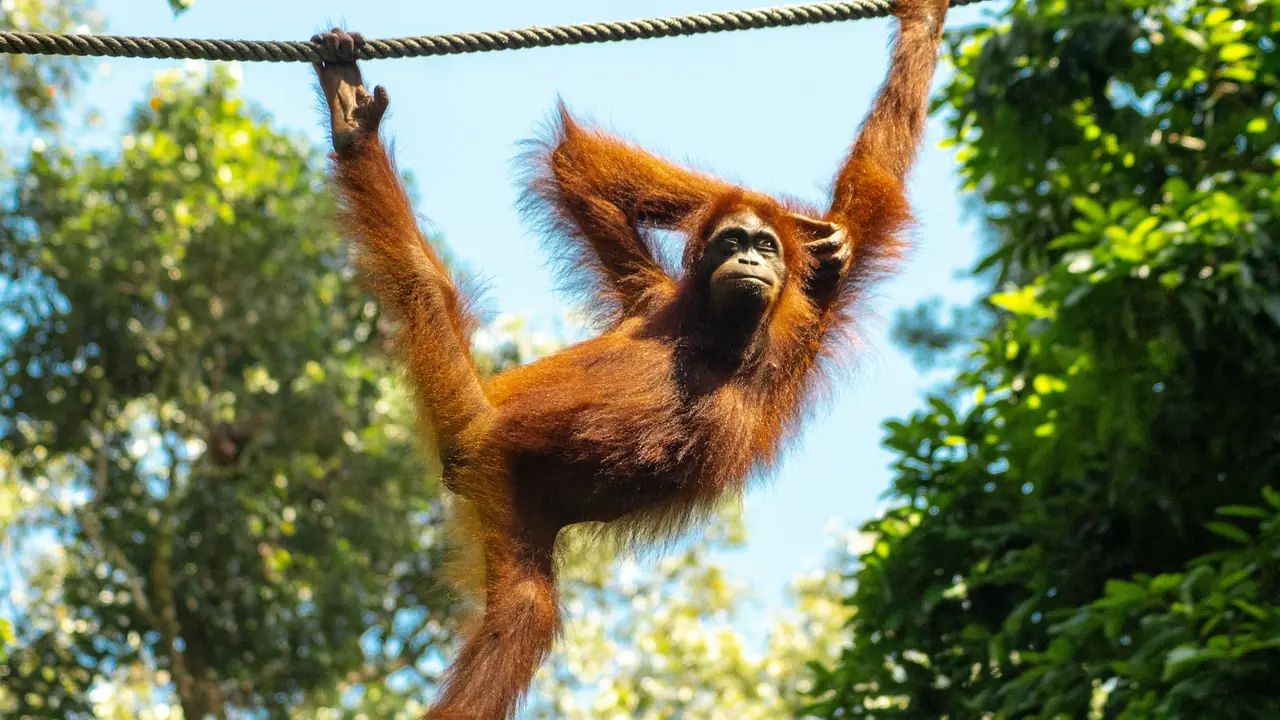
Researchers at Tel Aviv University have documented a rare and spontaneous behavioral display at the Ramat Gan Safari, where two western lowland gorillas built a "living ladder" to bypass an electric barrier and reach nutrient-rich foliage.
Coordinated Problem Solving Among Half-Sisters
The half-sister gorillas, Amalia and Lisha, divided specific roles during the coordinated effort. Lisha acted as a stable physical base while Amalia climbed onto her back, stretching upward to snap off branches located approximately 4.5 meters high. A protective electric barrier around the tree trunk had previously prevented direct climbing, forcing the animals to devise an alternative strategy. This unusual finding, which demonstrates advanced cooperation and spontaneous problem-solving without prior human training, was published in the scientific journal Primates.
The research was led by Michael Levitsky and Prof. Israel Hershkovitz from the Department of Anatomy and Anthropology at the Gray Faculty of Medical and Health Sciences and the Dan David Center for Human Evolution and Biohistory Research at Tel Aviv University, in collaboration with the Safari staff. The most thoroughly documented incident occurred in September 2024, after Safari keepers observed the two gorillas peacefully feeding on a local tree branch that had previously remained out of reach. Security camera footage confirmed that Lisha positioned herself stably on a rock beneath the tree, allowing Amalia to climb her back and reach the vegetation.
Repeated Patterns and Evolutionary Insights
Additional observations from 2021 and 2025 confirmed that the behavior followed a recurring pattern with identical role distribution. A video recorded in June 2025 captured Lisha proactively approaching and offering her back for support of her own completely free will. Researchers noted that this cooperation occurred despite the fact that the sisters do not frequently spend time together or groom each other in daily life, and the food acquisition did not always result in shared consumption.
Michael Levitsky, who initiated and led the study, emphasized the significance of the interaction. "When I first reviewed the footage, it was clear this was something extraordinary. What fascinates me is that Lisha did not merely serve as a stepping stone for Amalia, but actively and voluntarily participated in solving the problem by positioning herself in the exact right spot. This marks the difference between using another individual as an instrument versus genuine cooperation where both parties work toward a shared goal," Levitsky explained.
Yonatan Samucha, head of the primate department at the Ramat Gan Safari, added that the institution continually witnesses high intelligence, learning capabilities, and problem-solving skills among apes. Prof. Israel Hershkovitz concluded that such observations shed light on human evolutionary history, offering clues as to how early humans survived savanna conditions through social support and advanced cooperative frameworks operating independently of language and formal planning.