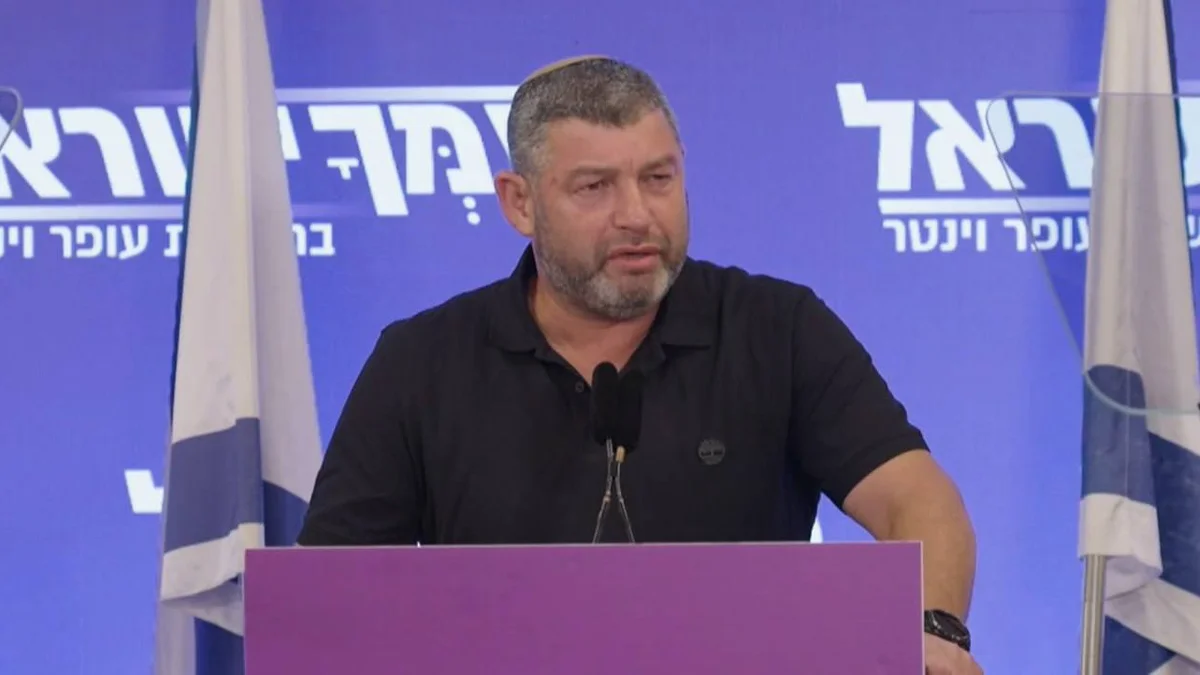
Gilad Erdan: "We will not join a narrow government"
In an extensive interview, Gilad Erdan refuses to commit to a political side. Despite not passing the electoral threshold in polls, he declares: "We will not join a narrow government." He explains why he does not trust Eisenkot and Bennett, and marks the key point: "The test of the third block - will we succeed in uniting."
While his colleagues in the Likud fought for a place at the top of the list, Gilad Erdan — until recently one of the party's stars — criticized the emerging composition in a campaign video: "The Prime Minister demanded a record number of reserved spots so that perhaps no one would notice that the Beitar spirit is no longer as present in the Likud movement."
This statement is a surprising step for someone who served as a senior minister and cabinet member, who marked himself as a candidate for the leadership struggle in the Likud on the day after Netanyahu, and chose precisely now to launch a political struggle at the head of a new party.
"After October 7, I understood that the most important thing is to fight for there to finally be a unity government here that can decide on the central issues," says Erdan. "I could have returned to the Likud and waited for the day after Netanyahu, but in the meantime, there is a country and hundreds of thousands of reservist families under a burden that is tearing us apart from within."
According to him, within the Likud, "it is impossible to really influence the critical issues. Who has influence? Deri and Goldknopf, and perhaps Ben Gvir. And the same on the other side — whoever votes for Eisenkot or Bennett will end up with Yair Golan or Abu Mazen (Mahmoud Abbas) controlling the agenda."
Unity as an instrument
Erdan emphasizes that his mission is to connect the blocks as a political instrument that may solve the difficult problems in Israeli society. To the question of why he does not define himself as a candidate for the role of the "61st finger" on behalf of the right, Erdan replies: "Whoever doubts me does so out of political interest. The public has known me and my positions for 30 years, and I will fight for these right-wing positions in the next government as well. If I clarify in advance that I am in someone's pocket, my political ability to bring the desired result is harmed."
"It is unity or we die... You want us inside, establish a broad Zionist government. We will not join a narrow government even if the price is another round of elections," he adds.
To the question of which of the candidates — Netanyahu or Eisenkot — he wants to see as Prime Minister, Erdan replies that the difference between the candidates is not the main thing: "A narrow government tears the people apart. My flag is to obligate all citizens of the country, including Arabs and secular, to give two years or more of service for the country. We are also for full recruitment, but we have not forgotten that we are also full right-wing. These will be the positions of the next government — it does not matter who stands at its head."
Security and recruitment issues
Erdan rejects the claim that Eisenkot cannot lead a right-wing government: "After October 7, 70-80 percent of the public understand that there must not be a Palestinian state." He clarifies that a government dependent on Yair Golan is out of the question, but a broad government in which Golan accepts national guidelines can be considered.
On the need for service by the Arab public, he says: "A gradual process must be started. Today the result is that because the Haredi public is exempted, the Arab public is also exempted. How many more years will we hold on with this?"
On the issue of the recruitment law, Erdan clarifies that in his formula there is room for an exemption quota for Torah students: "I am a graduate of the Nativ Meir yeshiva, my brother is Haredi, I understand the value of Torah study. A quota of Torah students is more important in my eyes than an exemption for outstanding athletes. We will need to reach a broad agreement — whether it is 5% or 7%."