Behind the scenes: Gaza demilitarization plan underway despite lack of formal agreement
Although agreements have not yet been officially signed, the IDF has tightened its policy of targeted killings in Gaza, and the Peace Council is advancing preparations for multinational forces. Simultaneously, pressure is mounting on Israel to expedite a partial troop withdrawal.
Although the agreements have not yet been officially signed on the Israeli side, Israel has significantly tightened the policy of targeted killings in Gaza, and the Peace Council has begun to advance work towards the entry of multinational forces. It has come to the attention of "Hayom" that the Peace Council has issued a tender for Israeli companies to build office buildings and accommodation for senior officials in the "yellow line" area captured by the IDF.
In addition, in the coming days, forces from Uganda are expected to land in Israel, joining the Moroccan forces that have already arrived in the Gaza envelope area, in preparation for entering Gaza. And against the backdrop of significant progress on the ground, there is also pressure behind the scenes on Israel to withdraw IDF forces back to the line of outposts before a total demilitarization.
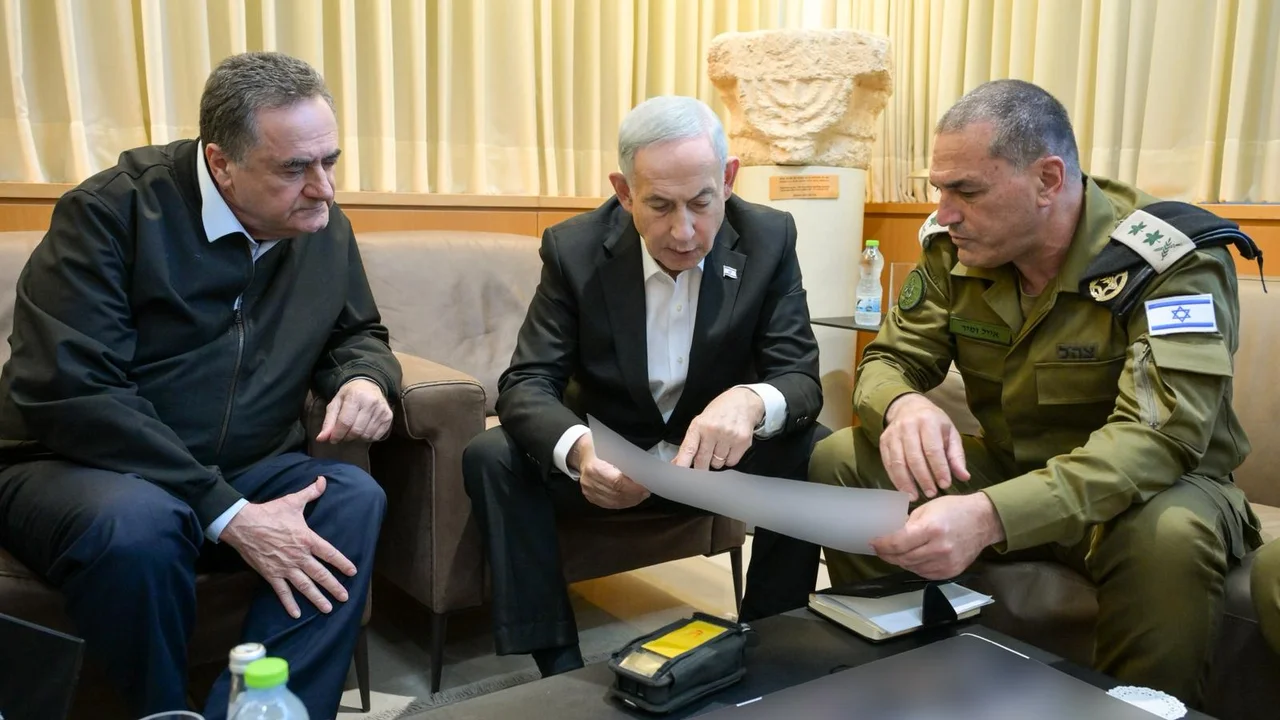
Yesterday, the Security Cabinet convened for a discussion on the Gaza front and the Lebanese front at the Prime Minister's Office in Jerusalem. As we revealed in "Hayom", the ministers discussed the two agreements with the Peace Council, which have not yet been signed and are at the basis of activating the multinational forces and beginning the implementation of the demilitarization, withdrawal, and reconstruction plan in Gaza. The first agreement was approved in principle at the previous cabinet meeting for the activation of the military force in the Strip. The agreement determines which countries will be members of the force's operating body, but at that same meeting, Minister Bezalel Smotrich demanded to amend the agreement and allow only countries with which Israel has diplomatic relations to operate the force (i.e., not Qatar), and only then to sign it.
The second significant document discussed in the cabinet is the roadmap for beginning the implementation of the demilitarization, reconstruction, and withdrawal plan led by the Peace Council following the agreements with Hamas on demilitarization. The cabinet was also required to approve it, against the backdrop of public opposition from ministers Itamar Ben Gvir, Bezalel Smotrich, and Orit Strock to its approval, and Benjamin Netanyahu's demand to amend many of its clauses before it is implemented. However, on the ground, as mentioned, this week the IDF began the 14 days preceding the start of disarmament, during which the policy of targeted killings will be significantly tightened.
Last night, the heads of the Gaza envelope councils appealed to the cabinet ministers with a demand to determine that full demilitarization of the Gaza Strip will be a prerequisite for any move of reconstruction, transfer of powers, or further withdrawal, contrary to the roadmap and the agreement, according to which the demilitarization and withdrawal will be mutual and gradual. The council heads clarified that the responsibility for the security of the envelope communities must remain in Israel's hands, alongside the ability to act independently against any renewed threat. According to them, "After October 7, Israel no longer has room for mistakes based on assumptions or external supervision. The reconstruction of the Strip cannot precede the restoration of security and the restoration of the trust of the envelope residents in Israel."
Meanwhile, the "Tzav 9" movement has begun a campaign against the implementation of the agreement throughout Israel. "Clause 17 is the most dangerous part of the agreement. Even if Hamas is not ready to disarm, and that is what is happening now, they are starting to reconstruct the Gaza Strip. In this entire area of the yellow line, in these areas that the IDF captured, they are allowing the population to enter and exit. Hamas will still have the weapons," said Reut Ben Haim, one of the organization's leaders.
"They are bringing in international forces, starting reconstruction inside the Gaza Strip, but Hamas is still armed, and they can continue to move around there. It's only a matter of time. We are actually reconstructing and preparing the infrastructure for him, and he gets a reconstructed Gaza as he wants, in order to prepare the next massacre. They are presenting it as a reconstruction plan. This is not a reconstruction plan, this is a resuscitation plan for terror."