How an Italian Village Was Erased to Build a Doomed 'Las Vegas'
Discover the haunting story of Consonno, an Italian village transformed into a 1960s entertainment oasis before landslides and abandonment turned it into a ghost town.
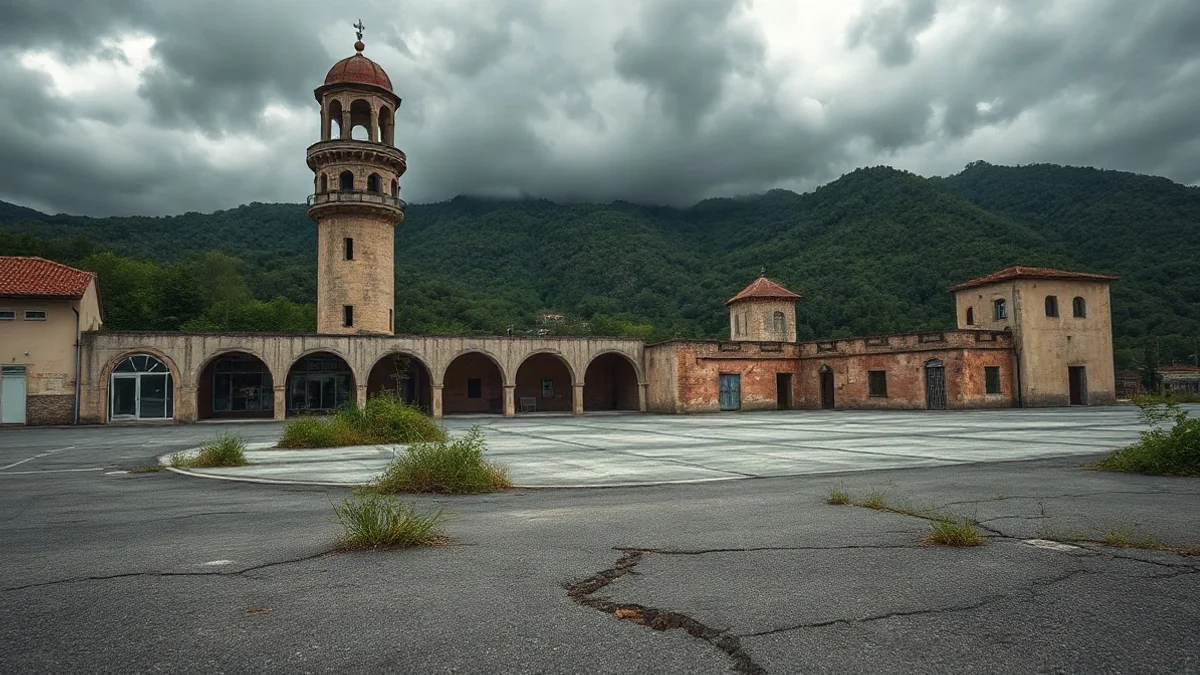
Hidden among the green hills of northern Italy lies a ghost town that looks straight out of a horror film. A mosque-like minaret towers over a crumbling shopping center, walls are covered in graffiti, and weeds burst through cracked pavement. It is hard to believe that in the 1960s and 1970s, crowds flocked here for hotels, parties, and concerts, earning the place the nickname "the Las Vegas of Brianza," after the region north of Milan.
This ghost town is called Consonno, and its story began with the dream of a single man: Mario Bagno, a wealthy and eccentric contractor who decided to turn a quiet farming village into a massive entertainment city designed to attract tourists from all over Italy. However, the path to fulfilling this dream involved destroying almost the entire original village and forcing its residents to leave.
Until the early 1960s, Consonno was a small agricultural settlement in the Lombardy region, where residents made a living from farming and local crafts amidst stone houses, barns, and an ancient church. Everything changed in 1962 when Mario Bagno, who made a fortune in road and infrastructure construction, purchased the village for 22.5 million Italian lire of that era.
The Rise and Fall of the Entertainment Empire
Bagno envisioned an entertainment hub where visitors could dance, shop, and watch shows without needing to leave its borders. To achieve this, he systematically demolished old homes and evicted residents, with some families reportedly forced out while children were still doing homework inside. Only the ancient Church of San Maurizio, the rectory, and the cemetery were spared.
Using dynamite to clear a hillside that blocked the mountain view, Bagno built eclectic structures inspired by global architecture: a Middle Eastern-style shopping gallery with a minaret, a Chinese pagoda, medieval-style arches, and grand fountains. A hotel, restaurants, and dance halls accompanied these projects, while plans also included sports fields, swimming pools, a mini-golf course, a zoo, and a racetrack.
For a few years, the gamble paid off. In the late 1960s and early 1970s, Consonno became a bustling hotspot for weekend parties, concerts, and Italian celebrities. However, the extensive earthworks severely destabilized the local terrain. Heavy rains triggered landslides, and a major landslide in October 1976 cut off the main access road, plunging the resort into a steady decline from which it never recovered.
Consonno Today: A Ghost Town and Tourist Curio
Subsequent attempts to revive the site—including turning part of the Grand Hotel Plaza into a nursing home that operated until 2007—failed to bring back the crowds. Rave parties in the 2007 era caused further damage to the abandoned structures.
Today, Consonno attracts urban explorers, photographers, and curious travelers looking for an eerie architectural anomaly. While local associations have historically tried to organize cleanup events and skateboarding meetups, recent property owner restrictions have tightened access, making unauthorized entry into dilapidated buildings both illegal and hazardous. Nearly fifty years after the landslide that sealed its fate, Consonno stands silently among the forest trees like a forgotten Hollywood set.