Israel Police Launch Historic Volunteering Pilot for Special Needs Youth
Eleven students with special needs from Holon received police uniforms in a historic pilot program. They will volunteer weekly at Israel Police canine and cavalry units.
Eleven students aged 11 to 21 from the "Meytarim" school in Holon, some on the autism spectrum and others with learning disabilities, received police uniforms this morning at the cavalry farm in Beer Yaakov. For the first time in the history of the Israel Police, they have been accepted as volunteers as part of a pilot program designed to test whether a permanent track can be built for them within the system.
Emotional Moments and Family Ties
For several families, the ceremony carried an additional dimension. Among the young participants are those whose fathers or brothers already serve in the police, and the family members in uniform were the ones who handed over the uniforms to them. Thus, at the same ceremony, those accustomed to leaving home in police uniforms passed them on this time to a son or brother joining the framework through a different path.
However, behind this moment lies a much more practical experiment. The 11 participants will not receive police powers and will not engage in operational activities. Once a week, they will arrive at the canine and cavalry units in Beit Dagan and Beer Yaakov, participate in part of the base routine, and receive tasks tailored to their abilities, including working on the farm, handling equipment, and assisting with the ongoing operations of the units.
Preparing the Police Force
Yet the pilot is also intended to test the police officers who will work alongside the young people. They must learn how to communicate with them, understand their various difficulties, and adapt the work accordingly. This connection may also be relevant to their work outside the base: police officers encounter citizens with disabilities during emergency events, investigations, and distress situations, where it is not always easy to immediately understand the source of a person's behavior.
This is one of the reasons the police chose not to settle for an introductory day or a one-time activity. The receiving officers will undergo preparation, and a personalized program will be tailored for each participant to accompany their volunteering.
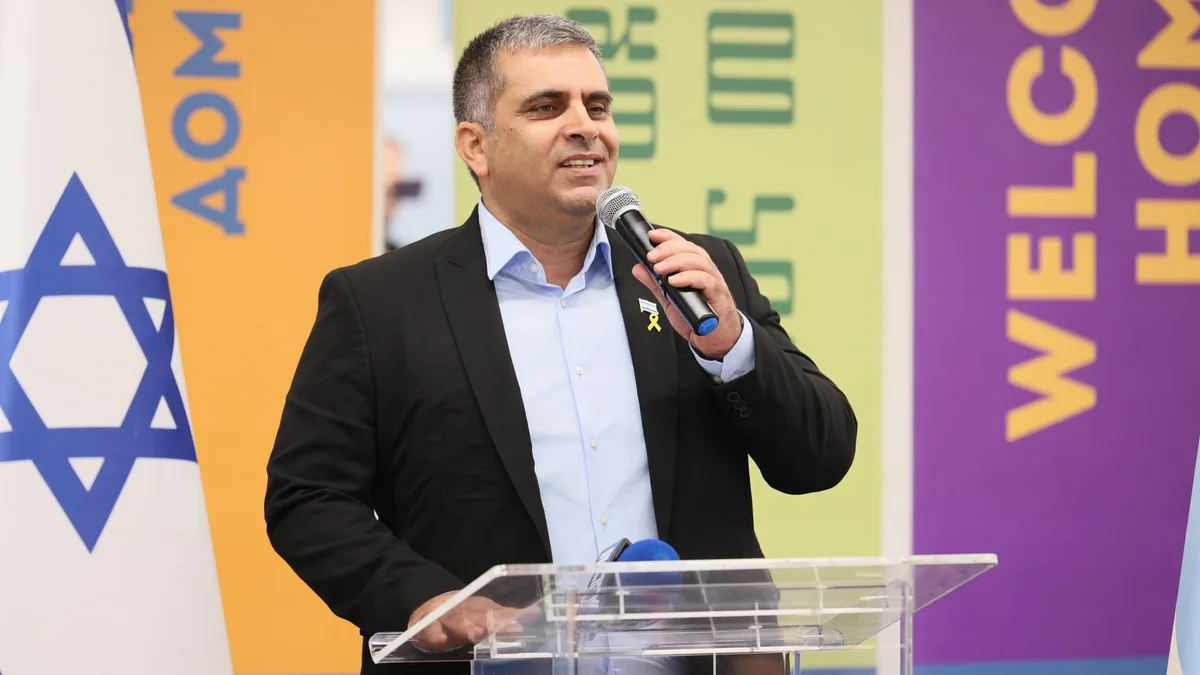
The ceremony this morning was attended by Head of the Operations Directorate, Deputy Commissioner David Filo; Head of the Policing Division, Assistant Commissioner Nati Gur; Head of the Communities and Volunteers Division, Assistant Commissioner Sigal Toledo; and "Meytarim" School Principal Ravit Meged.
Future Prospects and National Service
The 11 students are the first trial group. The Police Commissioner gave his blessing to the initiative, and the police are already looking ahead to the next stage: if the pilot succeeds, the intention is to examine the creation of a permanent framework for young people with special needs.
For the students, this is meant to be a framework different from what they know at school. They will have a commander, receive tasks and instructions, and be required to attend a regular volunteering day. The school regards this day as a sort of classroom outside the school—only this time it is located inside a police unit.
The more interesting question will arise in a few years. Some of the participants received exemptions from military service and are expected to finish their studies at age 21. Until then, the police intend to check whether a path can be built allowing those who are suitable to transition from volunteering into a police framework as adults, alongside the possibility of integrating into national service.
If the pilot passes the test of reality, it may open a door for the first time that did not previously exist for those who wanted to be part of the police framework—but until now had no path to enter it.