"Decided he wouldn't leave without something in hand": The deals Eitan Mor made with the terrorists in Gaza
Dr. Zvika Mor says his son Eitan learned Arabic in captivity and now blends into Arab cafes, attacks the Hostages and Missing Families Forum, and claims Hamas saw the square as a pressure tool. Regarding Gaza, he states: "The only solution is settlement."
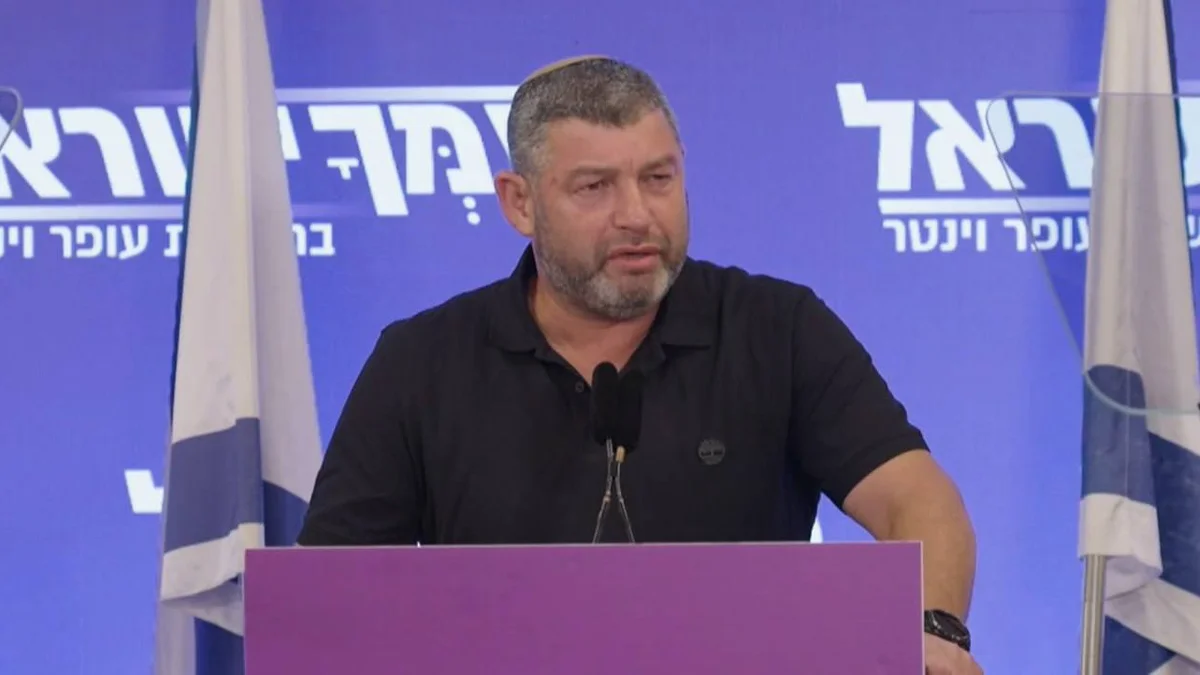
For two long years, Dr. Zvika Mor was an unusual voice among the families of the hostages. While the "Hostages Square" was in turmoil, he spoke about national resilience, about not surrendering to terror, and about victory as the only way to bring the boys back. Today, with his son Eitan already home, Mor is not resting. He is joining the leadership of the "Religious Zionism" party and intends to bring the insights distilled from the hardest year of his life into the corridors of the Knesset. In a conversation with Einat Miron on the Maariv podcast, he provides a rare glimpse into what his son went through in captivity, what happens behind the scenes in the Prime Minister's office, and how he plans to change the face of the country.
"Eitan sits in Arab cafes and they don't know he's Jewish"
Zvika, let's start with the most important thing. How is Eitan? How is he feeling today, a year after that terrible Simchat Torah? "Eitan, thank God, is doing just fine. He is really returning to himself, has become very strong, and has returned to being the son we knew. Physically, he has returned to training hard, the color has returned to his face. He also returned to training and combines meeting friends with training and learning Arabic." You said he took learning Arabic "a step forward" while he was held by Hamas. "Correct. Eitan decided he wouldn't leave captivity without something in hand. For two years, he simply learned Arabic. He made 'deals' with his captors and other prisoners: 'I will teach you English, you will teach me Arabic.' He asked them to write the letters for him, learned the writing, but mostly questioned them about their culture. He asked everything: how they get married, what the relationship is between the groom and the bride's parents, what their values are. That is what kept him sane inside the cage and the closing walls." And how does it look today, now that he is free? "It's amazing. Today Eitan walks around Jaffa, Ramle, and Lod, sits in Arab cafes, and they don't know he's Jewish. He adopted the accent, the slang, the body language. He literally 'covered' himself in this identity. We really hope he will be able to contribute to the country with this knowledge in the future. In the meantime, we are writing a joint book together. Eitan was with us throughout the struggle in spirit, even though we were not in contact. It turned out in retrospect that he held exactly the same position as we did: that the country should not change because of him, that he is not the most important thing here, and that it is forbidden to release terrorists who will murder other Israelis because of him. This book is about to be released right after the holidays."
"They took the hostages' families hostage"
While Eitan was in captivity, you became a political figure, and now you are running for the Knesset in the fourth spot on the Religious Zionism list. There were those who asked 'where did you disappear to' recently. "I didn't disappear, I dedicated myself to preparing for this mission. I hope to be a faithful messenger. When my son was in captivity, I didn't say 'burn the country to bring him to me.' I said 'save my son so that I will be the last parent in the country to experience a kidnapping.' I don't want anyone to go through this hell. My spot on the list is not 'identity politics' of a hostage's father, but because I believe in the path."
You have sharp criticism of what happened at 'Hostages Square' and in the Families Forum. "We said from the beginning: they took the hostages' families hostage for political needs. Elements with a clear agenda managed the campaign. The slogan 'Now, now' was intended to weaken the country's resilience against Hamas. When we saw that the campaign was directed against Religious Zionism with expressions like 'the great commandment of redeeming captives' — it was a cynical attempt to pressure the religious public and confuse it, instead of focusing on defeating the enemy. Eitan told us when he returned that his interrogators asked him: 'How do you bring more Israelis to Hostages Square? We want the square to be full.' Hamas saw this square as an event that supports it."
I must confess, I also had an internal aversion to coming to the square because of this feeling of manipulation. "I understand you. There was cynical action there using the families' pain to sow political seeds. I went to the squares, gave lectures in Hebrew and English, and explained why this approach harms the war efforts and the hostages themselves. My only regret is that I didn't manage to create strong enough personal connections with the families who opposed me to try to convince them in a quiet conversation. This polarization hurts me a lot. My young daughters went to the headquarters naively to say thank you to the volunteers, and were shouted at 'It's all because of you.' It was shocking."
"The intelligence lost the connection"
You participated in many meetings with the Prime Minister. What does the public not know about what happens there in the closed rooms? "These are not simple meetings. The Prime Minister cannot reveal everything to us. My role was to ensure he doesn't break. He committed in every meeting that he would return everyone, but also clarified: 'I am responsible for 10 million citizens, I will not make a reckless deal of surrender.' Not many know, but there was a very difficult period, a few months where our intelligence simply 'lost the eye' on Eitan. They told us they didn't know what was happening with him. It was terrible uncertainty. Eitan survived by a miracle IDF bombings that landed a hundred meters from him. He saw how they continued to dig tunnels at a rate of a meter a day even during the fighting." Are there families who support your approach but are afraid to speak? "Absolutely. In the 'Tikva Forum' we have monthly meetings with dozens of families. Some come secretly, without photos, because they are afraid of the treatment they will receive from other families or the media. It is sad that there is no real freedom of opinion within this pain."
"We gave them 100% of the territory and got a massacre"
"One must distinguish between moral and legal responsibility. On the moral level, people like Ronen Bar, Aharon Haliva, and Herzi Halevi should sit at home quietly. They failed in their basic duty — protecting the border. I compare it to a school principal whose guard fell asleep. If the principal checked the guard and everything was fine, and the guard played on his phone at the moment of truth — the guard is to blame. But here there were thousands of early signs. To say 'error in judgment' is not enough when it comes to thousands of terrorists. A commission of inquiry is critical, not for revenge, but for correction." How do you intend to deal with the violent discourse in the Knesset? With people like Yair Golan, for example? "I come with an approach of 'calm firmness.' I am ready to sit with anyone for a dialogue, without stigmas. If Yair Golan is with me in the room, I will ask him hard questions: 'When you call the 'Bnei David' institutions fascist, what do you mean? What will you say to the families of the 34 fallen from this institution?'. One needs to take the hatred out of the heart. The verse says 'Do not hate your brother in your heart... you shall surely rebuke your neighbor.' To talk, not to be silent, but not to hate. I demand from every candidate to declare in advance that they accept the election results. We will no longer agree to burning roads and creating chaos because the result doesn't look good to someone."
The vision: education, identity, and "Hebrew labor"
Suppose you are already in the Knesset. What is the first issue you will address? "Two central arms: Jewish identity and security. In education, I want to change the paradigm. Why must everyone learn mathematics until 12th grade? Whoever is strong — let them be a scientist. Whoever is not — let them develop their talents in other areas and be happy and productive. We need to return to 'Hebrew labor.' We saw what happens when you rely on Arab workers — damage to infrastructure, intelligence gathering, and hospitals like Rambam where there is suspicion of abusive treatment by Arab staff towards wounded IDF soldiers. This needs to be cut off brutally." And what about Gaza? "We must not stop. The 15-point plan they talk about is a deception. Any weapon that remains in warehouses in Gaza will be turned against us again. The only solution is settlement. We gave them 100% of the territory and got a massacre. Only a Jewish presence will ensure security. When I entered politics, I didn't ask Netanyahu what he thinks, but I assume he understands the need for people who push towards these goals." Finally, Zvika, what strengthens you in this not-so-simple public struggle? "The connection to the roots. I live in Hebron, breathing the history. Last week we marked the 1929 massacre — 67 Jews murdered in ways amazingly similar to October 7, even before there were 'settlements' or a state. They always want to destroy us. What gives strength is the Jewish identity. There is no coercion in Judaism, but one must know who we are. If Maimonides entered the room now, we could study together as if a thousand years hadn't passed. This is our miracle, and this is my mission in the Knesset — to ensure this miracle continues to exist in security and pride." The full podcast will be uploaded later on "Maariv".