Inside the Brief, Beautiful Life of Israel's Largest Giant Moth
Discover the giant peacock moth, Israel's largest moth, which lives for just days without eating, driven solely by a frantic 24-hour mating marathon before dying.
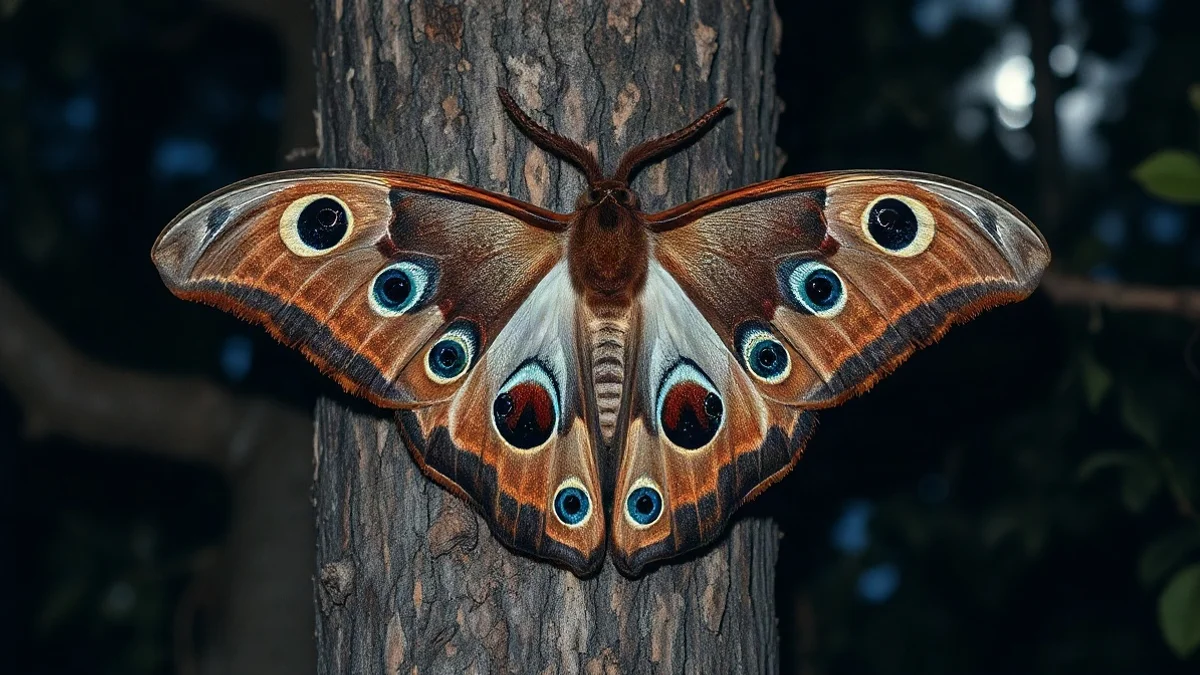
When night falls, nature reveals some of its most magnificent and ephemeral creatures. Among them is the giant peacock moth, known scientifically as Saturnia pyri, which holds the title of the largest moth species in Israel. With a wingspan that can easily match the palm of an adult hand and striking eyespot markings on its wings, it is an unforgettable sight. Yet, encountering this majestic insect outside of a museum has become an increasingly rare event in recent decades.
A Race Against Time
Unlike butterflies, which are far more familiar to the general public, moths make up a vastly diverse order of insects with ten times more species. The giant peacock moth follows a fascinating and delicate life cycle beginning as an egg, developing into a caterpillar, transitioning through a pupal stage, and finally emerging as an adult. The caterpillar does all the growing, feeding voraciously on trees from the Rosaceae family, such as almond trees, from which the moth derives its Hebrew name. Once the adult moth emerges from its cocoon at the end of winter, it faces a severe time crunch.
Adult giant peacock moths completely lack digestive organs and mouthparts, meaning they cannot feed or replenish their energy once they emerge. They live entirely on stored biological energy, much like running on a fixed battery. Because their lifespan lasts only two to three days of active life, males rely on feathery antennae to detect female pheromones from distances exceeding 10 kilometers. Mating lasts approximately 24 hours and culminates in the female laying hundreds of eggs to secure the next generation, after which both parents quickly exhaust their energy reserves and die.
Mounting Environmental Threats
Found across Europe and the Mediterranean basin, the giant peacock moth was once common throughout Israel from the Negev northwards. However, urban development, widespread pesticide use, light pollution, and climate change have severely fragmented its populations. Because the caterpillars feed on cultivated orchard trees that are regularly sprayed, even distant agricultural spraying can prove lethal. Furthermore, rising temperatures and severe droughts threaten the host trees, while increasingly frequent wildfires wipe out entire local populations that struggle to recolonize isolated habitats.
Beyond their aesthetic and ecological value as a crucial protein source for birds, amphibians, and reptiles, moths play a vital role in the food web. Researchers currently track declining moth populations using light sheets that attract nocturnal insects for documentation and laboratory analysis. While formal conservation efforts are lacking in Israel, nature enthusiasts can aid scientific monitoring by photographing and reporting sightings on platforms like iNaturalist.