Retired US General Proposes Transferring Stored F-15 Jets to Ukrainian Air Force
A retired US general has proposed transferring 50 to 60 stored F-15C/D fighter jets from Arizona to Ukraine to bolster the nation's air defense against Russian forces and relieve operational pressure.
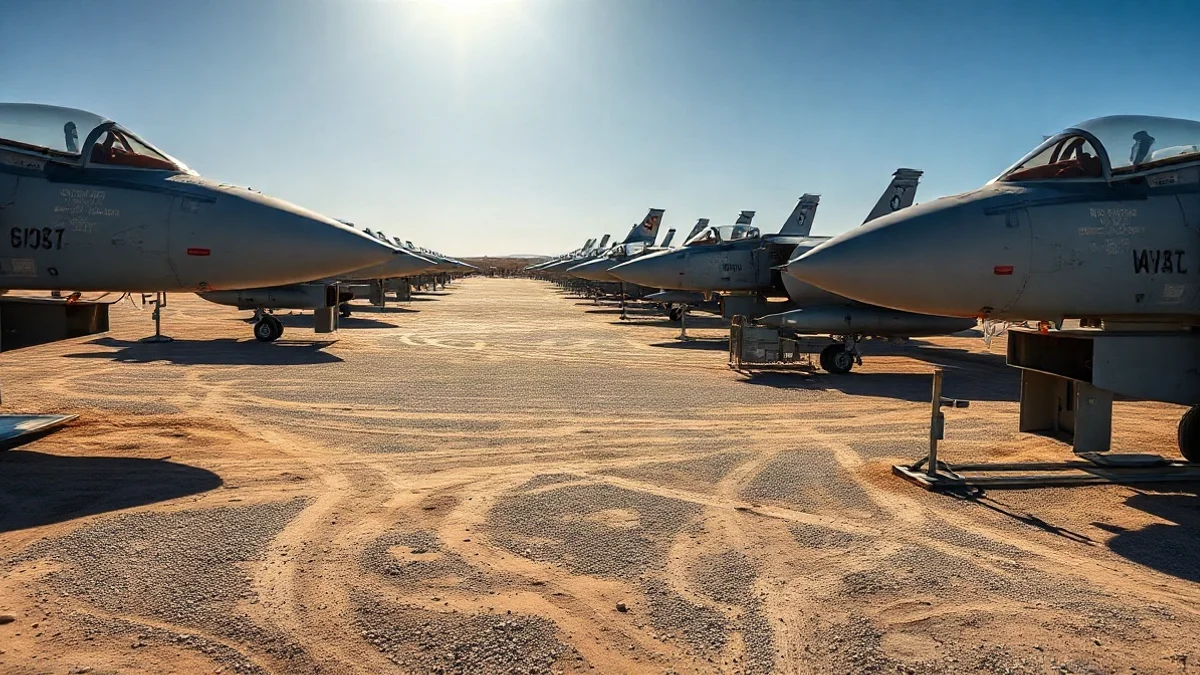
A retired United States Air Force general has proposed a dramatic solution to alleviate the critical aircraft shortage facing Ukraine by restoring 50 to 60 retired F-15C/D fighter jets from storage in Arizona and transferring them to the Ukrainian Air Force.
Strategic Reserve in the Arizona Desert
More than 240 F-15C and F-15D fighter jets are currently housed at the Davis-Monthan Air Force Base in Arizona, a facility widely known as the aircraft boneyard. These aircraft were placed in storage as Air National Guard squadrons transitioned to newer F-35 and F-15EX platforms, with the 104th Fighter Wing transferring its final F-15C jets to storage in October 2025. The facility is not a scrapyard but a strategic logistics center where nearly 4,000 aircraft and 6,650 engines are maintained under dry desert conditions that minimize corrosion.
The US Air Force categorizes stored aircraft into four distinct groups ranging from Type 1000 for long-term preservation with the potential for reactivation to Type 4000 for dismantling and parts harvesting. According to an analysis by retired General David Deptula, who submitted his proposal to the Pentagon and US government officials, many of the stored F-15C airframes are equipped with advanced APG-63(V)3 active electronically scanned array radars that offer superior detection range and tracking reliability compared to the radar systems currently operating on Ukrainian aircraft.
Operational Advantages and Firepower
Designed primarily for air superiority and interception, the twin-engine F-15 can carry up to eight air-to-air missiles and features an internal 20mm cannon loaded with 940 rounds, nearly double the 511-round capacity of the F-16. Deptula emphasized that using the aircraft's cannon provides a cost-effective method for intercepting drones and cruise missiles while conserving scarce and expensive missiles.
Integrating the F-15 fleet into Ukrainian operations would allow these heavy interceptors to assume primary air defense responsibilities, freeing up existing F-16 and Mirage 2000 jets to focus on multi-role strike missions. Ukrainian President Volodymyr Zelensky has previously stated that the country requires two and a half times more combat aircraft airborne at any given time to secure its airspace against Russian air attacks.
Implementation Challenges and Road Ahead
While new fighter deliveries from global manufacturers are backlogged and unlikely to arrive in significant numbers before 2028, the mothballed F-15 airframes offer a rapid alternative. However, realizing this transfer involves substantial logistical hurdles, as the aircraft in Arizona require rigorous evaluation, repair, and reactivation.
Deptula has urged the US administration to direct the Air Force to conduct a formal assessment to determine the exact number of airframes that can be restored to operational status, alongside estimated timelines and budgets. Beyond technical refurbishment, the initiative would require comprehensive training programs for Ukrainian pilots and ground crews, the establishment of dedicated maintenance facilities outside Ukraine, and a steady supply of spare parts, engines, and compatible armaments.