ESA Images Reveal Stadium-Sized Crater From NASA Asteroid Impact Test
New European Space Agency images reveal the stadium-sized crater left by NASA's DART spacecraft impact on the asteroid Dimorphos, advancing planetary defense research.
Sixty-six million years ago, an asteroid impact altered the history of life on Earth and led to the extinction of non-avian dinosaurs. Today, planetary defense initiatives aim to ensure humanity is prepared if another celestial body threatens our planet.
In September 2022, NASA executed an unprecedented kinetic impact test by crashing a spacecraft directly into an asteroid at more than 22,000 kilometers per hour. The test successfully shortened the orbital period of the smaller asteroid by roughly 33 minutes. Four years later, newly released images from the European Space Agency reveal the dramatic physical consequences of that high-speed collision.
Revealing the Impact Site
The new photographs were captured by the Hera probe, which launched in 2024 to study the aftermath of the impact. Following a two-year journey through space, the spacecraft reached the Didymos binary asteroid system, located approximately 193.5 million kilometers from Earth.
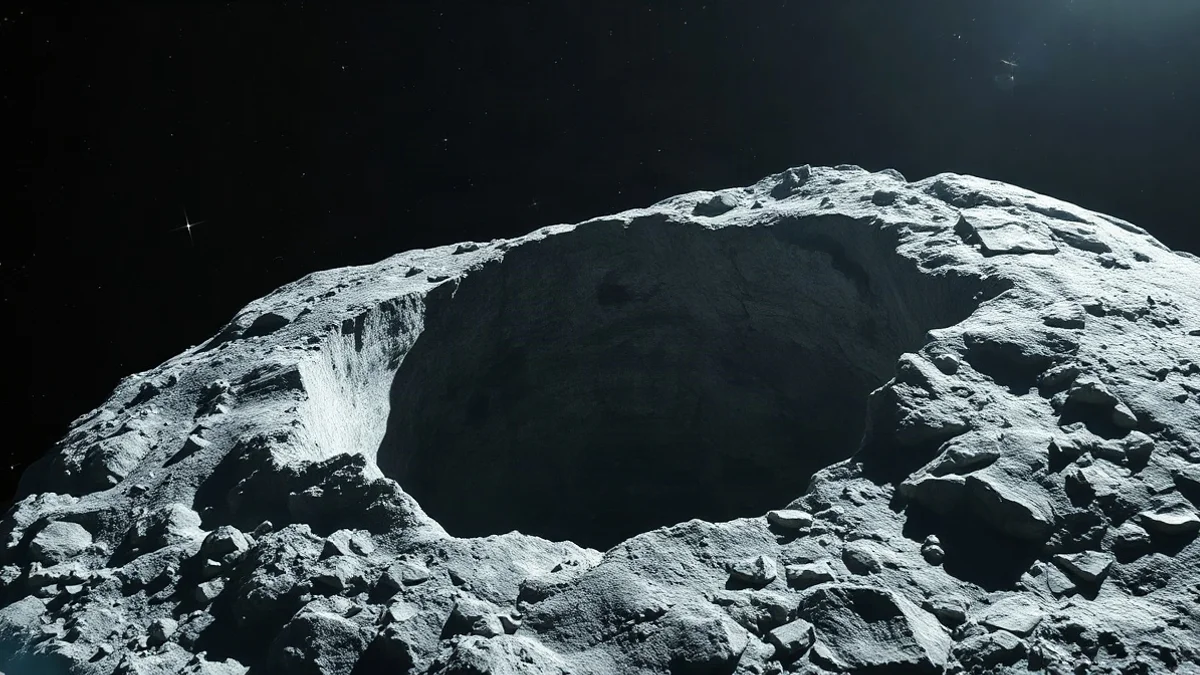
Dimorphos, the smaller asteroid with a diameter of about 151 meters, absorbed the direct strike. The imagery shows that one side of the body was severely flattened, creating an enormous stadium-sized crater at the impact zone.
Michael Kueppers, Hera mission scientist, noted that the crater spans the entire impacted flank, making it appear as though a section of the asteroid was carved away. Interestingly, the opposite side showed no significant structural alterations, and surface boulder fields remained largely unchanged compared to pre-impact documentation.
Chaotic Spin and Future Phases
The collision not only reshaped the asteroid but also left it in a chaotic rotational state. Long-exposure photographs further revealed hundreds of previously unknown boulders, each several meters wide, drifting in orbit around the binary system.
These newly discovered debris fragments present an unexpected navigation challenge for the mission team as they plot the trajectory of the probe. In December, Hera is scheduled to approach within 13 kilometers of the asteroids to capture higher-resolution imagery, followed by the deployment of two shoe-box-sized CubeSats in January 2027 to investigate internal structures and compositions.
Although neither Didymos nor Dimorphos poses any actual threat to Earth, the binary system serves as a crucial testing ground for planetary defense. By unveiling the data at the Natural History Museum in Berlin, space agencies emphasized that unlike the dinosaurs, modern civilization now possesses the technological tools to detect cosmic hazards and potentially deflect them before disaster strikes.