Chinese Doctor's Tombstone Engraved With 100 Secret Medical Formulas Draws Crowds
A granite tombstone in central China engraved with 100 traditional medicine formulas has become a pilgrimage site, drawing hundreds of daily visitors seeking secret remedies.
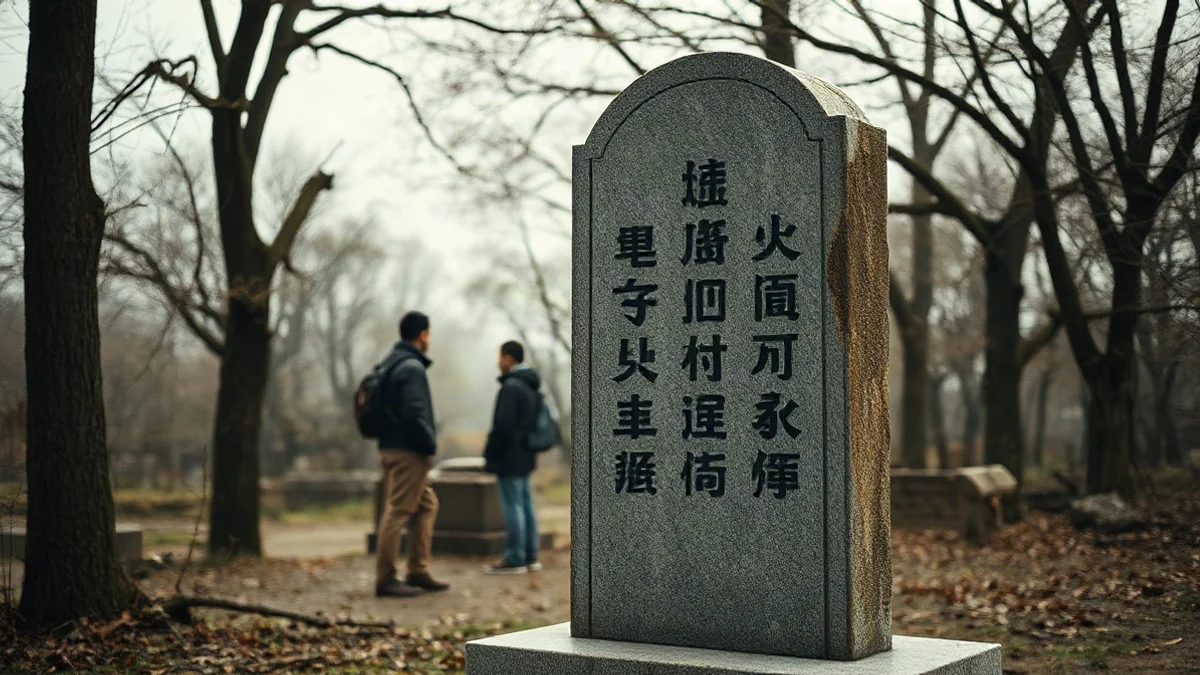
An unusual granite tombstone in central China has unexpectedly transformed into a major pilgrimage site for traditional medicine practitioners. Located in the village of Fanlongqiao in Henan province, the monument is densely engraved on both sides with one hundred traditional Chinese medicine formulas, detailing exact botanical ingredients and precise dosages.
The monument marks the resting place of Yuan Shufang, who began treating patients at the age of 16, specialized in gynecology, and practiced for more than 80 years. Throughout her career, she charged only two jiao per visit—amounting to less than a shekel—and donated her earnings to poverty alleviation efforts. Before passing away in 2006 at the age of 97, she handed her collected remedies to her son, Wang Tai-sheng, with explicit instructions to carve them onto her grave.
Breaking Ancient Medical Secrets
According to her family, Yuan believed deeply that her medical knowledge belonged to the public rather than to herself. Her dying wish was for the formulas to be permanently displayed so that future generations could heal without financial burden or at least pay significantly less for care.
This act breaks sharply with an ancient rule in traditional medicine encapsulated by the adage: "Pass on the formula, but not the dosage." Many practitioners traditionally guard their recipes as strict family secrets, withholding precise quantities even when sharing ingredients. Yuan, by contrast, documented everything comprehensively, with formulas spanning gynecology, pediatrics, and surgery.
A Viral Sensation Draws Crowds
For more than a decade, practitioners occasionally visited the grave to copy the inscriptions. However, attention skyrocketed after local media coverage went viral online. Reports indicate that between 300 and 400 visitors now arrive daily from distant provinces such as Shandong, Guangdong, and Guizhou.
Travelers have gone to extraordinary lengths to reach the site. One visitor endured a three-day journey from the city of Guiyang involving four to five train and bus transfers, while another woman flew in with her daughter, a third-year medical student who carefully transcribed the texts into a notebook. Practitioners frequently sit before the stone for entire days to copy the formulas by hand.
Reflecting on the overwhelming response, grandson Wang Ke-zhong noted that his grandmother would be deeply gratified in the afterlife. He revealed that her handwritten manuscripts contain more than 200 formulas in total, which the family intends to publish once the original documents are fully organized. He also issued an important safety warning, emphasizing that while practitioners can learn valuable lessons from the texts, patients should not attempt to brew medications independently. Furthermore, the family clarified that a widely circulated viral photo online depicting an elderly white-haired woman alongside the story is completely fabricated, as the family preserves only one authentic color photograph of her.