Researchers Document Rare Ongoing Bond Between Bull and Donkey
Researchers in the Ethiopian Highlands have documented a rare, ongoing sexual and social relationship between a bull and a male donkey, challenging traditional views on animal mating and social bonding.
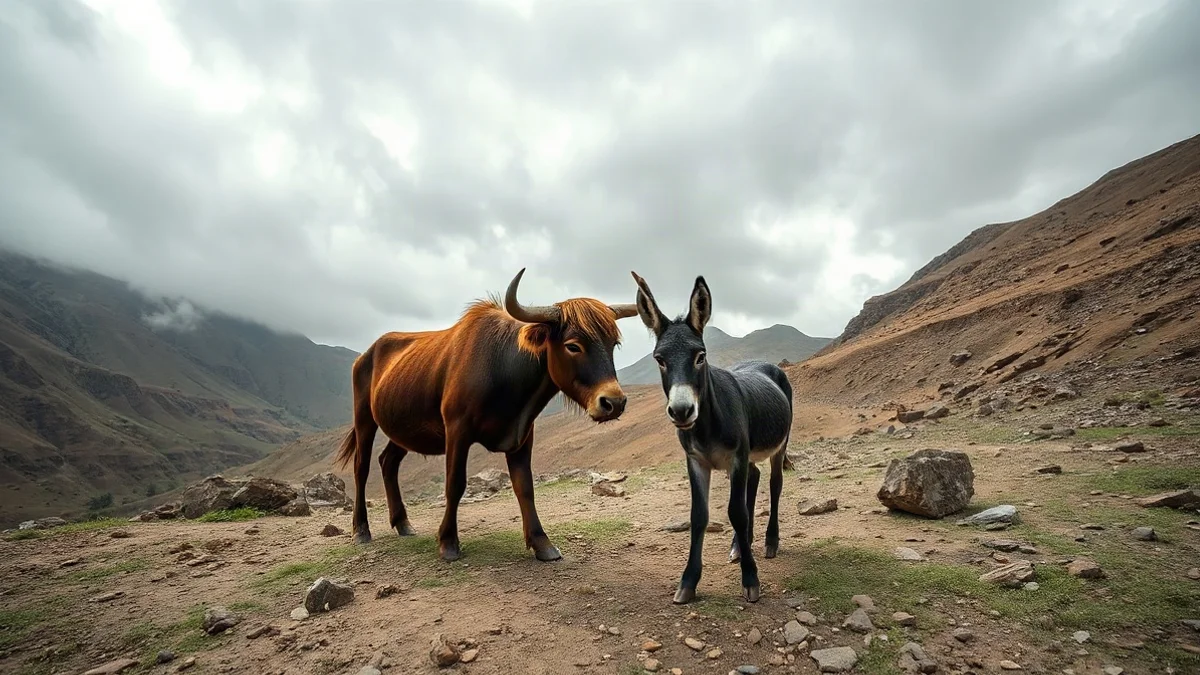
A rare and surprising case of an ongoing sexual and social relationship between a bull and a male donkey in the Ethiopian Highlands has been documented by researchers from the University of Pisa and published in the journal Current Biology.
An Unlikely Bond in the Pastures
While same-sex sexual behavior is relatively common in nature, the bond between a bull named Achilles and a male donkey named Patroclus stands out due to its exclusivity and consistency. The researchers, who named the animals after the figures from Greek mythology, observed that despite having access to potential partners of both sexes and their own species, the two animals consistently chose each other. Their interactions, which included grooming, nuzzling, and repeated mounting, took place during grazing periods when they met despite belonging to different owners.
"The interactions between Achilles and Patroclus were not one-off events," said Dr. Elisabetta Palagi of the University of Pisa. "What particularly caught our attention was the fact that these interactions were part of a selective and consistent social relationship between the two individuals." Between March 6 and March 19, scientists recorded 51 mounting instances, noting that Patroclus actively encouraged the behavior without showing defensive or aggressive reactions, unlike other animals approached by Achilles.
Implications for Animal Behavior
Lead researcher Martina Francesconi emphasized that the significance of the findings extends beyond interspecies mounting. The behavior reflects a complex social relationship characterized by consistent partner choice, challenging simplistic assumptions about animal mating habits. Researchers are now exploring the underlying mechanisms and potential evolutionary or social benefits of such unconventional bonds, seeking to understand how behavioral flexibility helps animals navigate complex social environments.