Israeli Envoy Recites Kaddish at WWI Jewish Soldiers' Graves in Belgium
Israeli Ambassador to Belgium David Saranga recited Kaddish at the graves of six American Jewish soldiers in Flanders, marking the centenary of World War I.
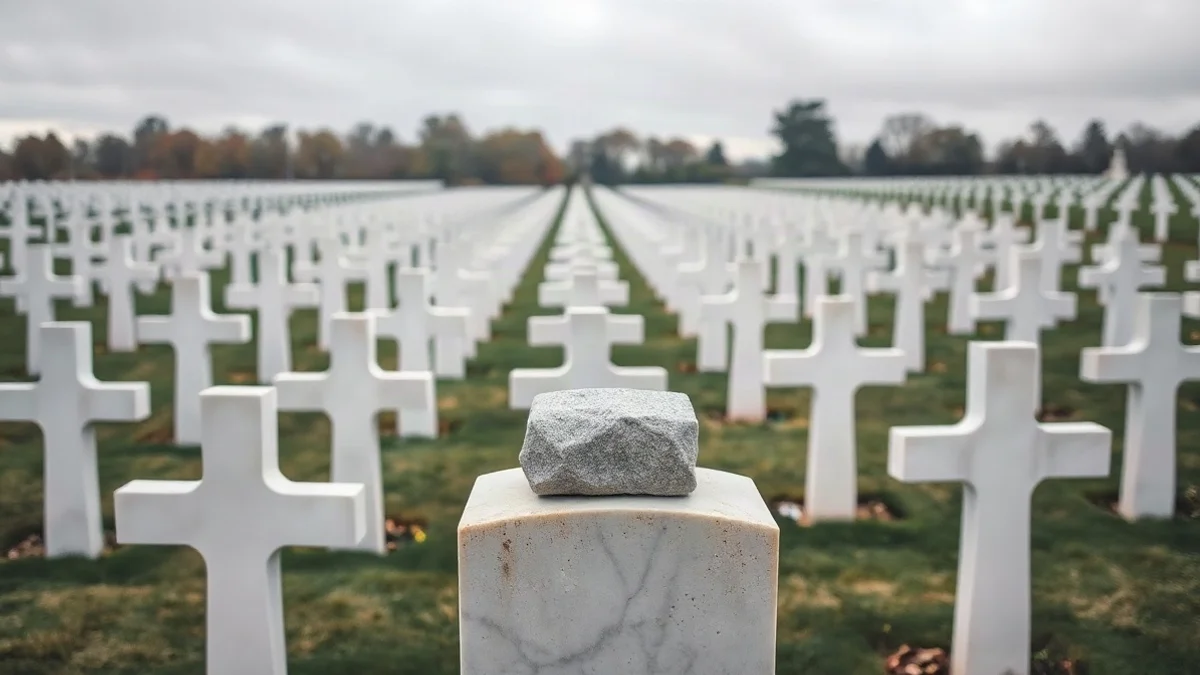
More than a century after the conclusion of World War I, Israeli Ambassador to Belgium David Saranga visited the Flanders American Cemetery in Waregem to recite the Kaddish prayer over the graves of six American Jewish soldiers. The solemn visit took place on the eve of Armistice Day, which marks the end of hostilities in November 1918. The cemetery holds the remains of 368 American military personnel, most of whom died during the liberation of Belgian territory, alongside a memorial wall bearing the names of 43 missing soldiers.
Remembering Fallen Jewish Servicemen
Among the fallen service members resting at the site are six Jewish soldiers: Samuel Jacobs, Arthur Segal, Jack Leder, Norman Stein, Erwin Mintzesheimer, and Morris Liebman. Their ages ranged from 19 to 40 years old. Describing his experience moving between the headstones, Ambassador Saranga shared a personal reflection on the tribute.
"I moved from grave to grave, heard the short life story at each one, shed a tear, recited Kaddish, and placed a memorial stone," Saranga wrote following the visit.
These six graves reflect a much broader historical chapter of Jewish participation in World War I. According to data from the IDF archives and defense establishment records, approximately 1.35 million Jewish soldiers served on opposing sides of the conflict across various militaries, including Russia, Austria-Hungary, Germany, France, the United Kingdom, and the USA. Roughly 250,000 Jews served in the American armed forces alone. Figures from the Jewish War Veterans of the USA indicate that about 3,400 of them died in combat. Across all fronts, more than 170,000 Jewish soldiers lost their lives, accounting for roughly 2 percent of the estimated 8.5 million total military fatalities. This dynamic often placed Jewish soldiers in uniform fighting on opposite sides of the front lines, sometimes directly against one another.
Historical Parallels and Contemporary Realities
The timing of the visit carried a poignant historical echo, as German forces entered the nearby city of Ypres in western Flanders on October 7, 1914. Saranga noted the heavy emotional resonance that this date now carries for Israelis, linking historical sacrifice and family grief with modern realities. Beyond historical remembrance, the ambassador connected the journey to the current geopolitical situation in the Middle East. He pointed to the post-war reconciliation among European nations as evidence that former adversaries can forge a shared future, while cautioning that lasting peace requires confronting the root drivers of conflict, specifically highlighting the military buildup and hatred incited by the terrorist organization Hamas.